

Researchers from National Taiwan University and Chulalongkorn University developed a copper-based catalyst system that improves low-temperature methanol synthesis from carbon dioxide hydrogenation by balancing two key steps in the reaction.
Carbon dioxide is best known as a major greenhouse gas, but it can also serve as a feedstock for making valuable chemicals. One important example is methanol, a widely used chemical for fuels, energy storage, and industrial manufacturing. The difficulty is that carbon dioxide is highly stable, meaning that its conversion into methanol usually requires harsh reaction conditions.
Developing catalyst systems that can drive this transformation more efficiently at lower temperatures is therefore an important challenge in sustainable chemistry.
Exploring a low-temperature strategy for methanol synthesis
In this study published in Applied Catalysis B: Environment and Energy, the researchers explored a low-temperature strategy for methanol synthesis in which ethanol helps redirect the reaction pathway.
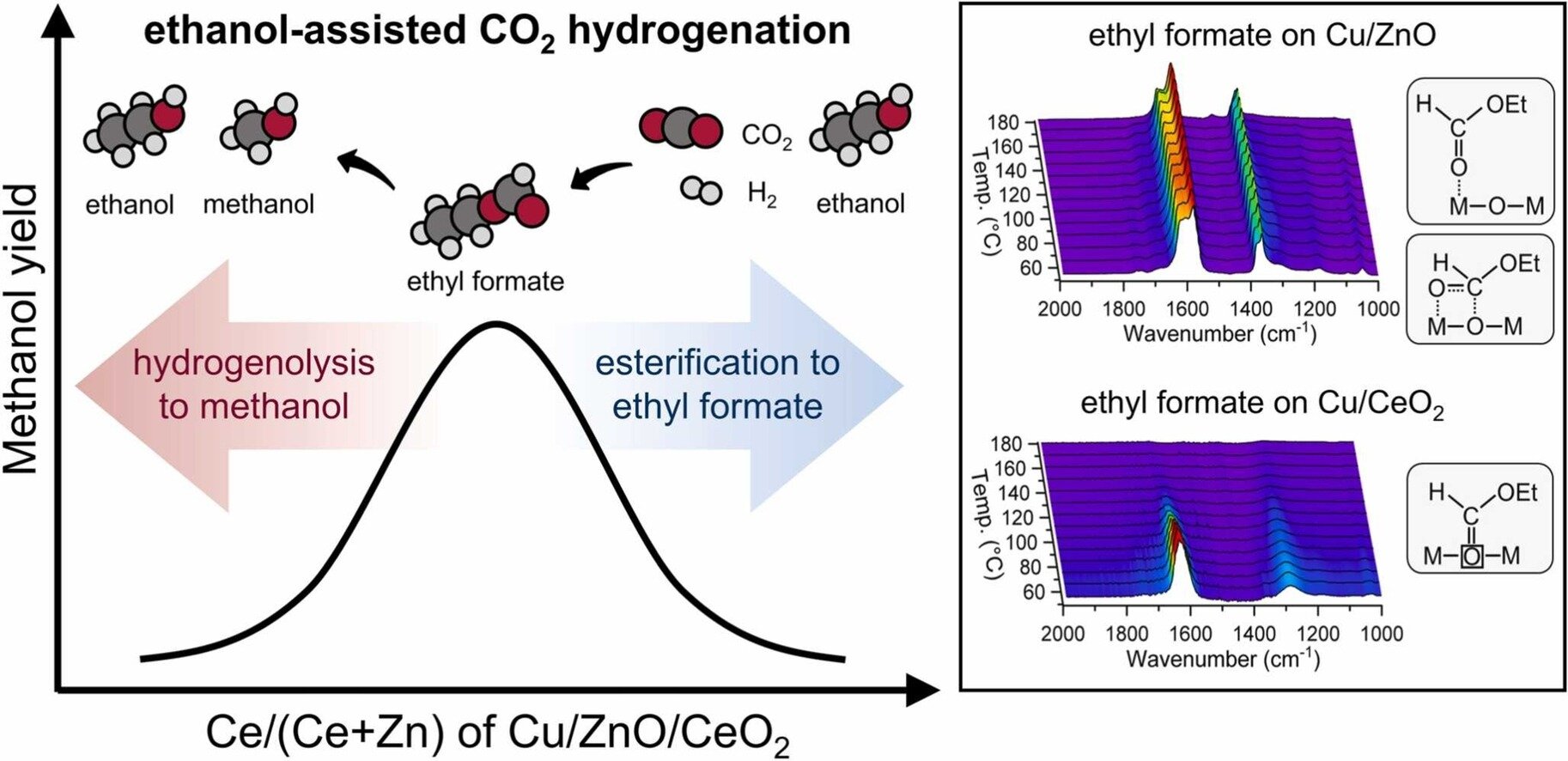
By comparing two copper-based catalysts, Cu/ZnO and Cu/CeO2, they found that two materials play distinct yet complementary roles. Cu/CeO2 is more effective at promoting the formation of a key intermediate, ethyl formate, while Cu/ZnO is more effective at converting that intermediate into methanol. This insight suggested that a catalyst combining both functions could deliver better overall performance.
To validate this idea, the team prepared a series of Cu/ZnO/CeO2 catalysts with different compositions. They discovered that methanol production did not simply improve as more Cu/CeO2 was added. Instead, the best result was achieved at an intermediate composition, where the catalyst reached the right balance between intermediate formation and conversion.
This volcano-shaped performance trend highlights an important principle in catalyst design: a highly effective catalyst must not only generate reaction intermediates but also keep them reactive enough to move efficiently toward the final product.
Using in situ infrared spectroscopy, the researchers then revealed why catalyst composition has such a strong effect on performance. In Cu/CeO2, the intermediate binds more strongly to surface defect sites, which renders its further conversion more difficult. In Cu/ZnO, the intermediate is more readily transformed into methanol.
Designing more efficient catalysts for low-temperature carbon dioxide conversion
These findings show how subtle differences in surface chemistry can determine the overall reaction outcome, and they provide a useful guide for designing more efficient catalysts for low-temperature carbon dioxide conversion.
"By balancing the catalyst functions responsible for intermediate formation and conversion, we are able to improve low-temperature methanol synthesis from carbon dioxide hydrogenation," says co-corresponding author Wen-Yueh Yu, professor of chemical engineering at National Taiwan University.
"We hope this work will provide useful guidance for the design of more effective catalysts for carbon conversion."
More information
Zhi Pin Law et al, Enhanced methanol synthesis from ethanol-assisted CO2 hydrogenation over Cu/ZnO/CeO2 catalyst by modulating surface intermediate reactivity, Applied Catalysis B: Environment and Energy (2026). DOI: 10.1016/j.apcatb.2026.126443
Provided by National Taiwan University