

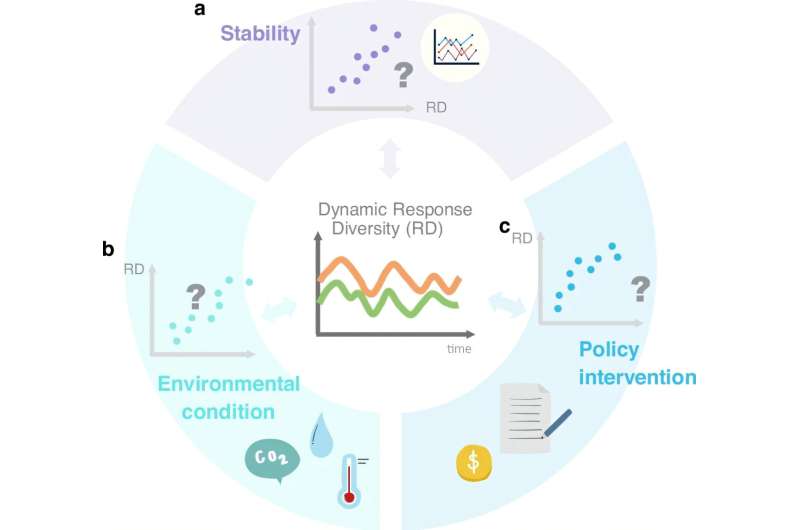
An international research team led by National Taiwan University has developed a new analytical framework based on Empirical Dynamic Modeling. This framework can quantify how response diversity varies over time using time-series data. Published in Nature Communications, the study offers the first direct empirical evidence that greater response diversity helps stabilize total community biomass. This breakthrough addresses a longstanding methodological challenge in ecology: measuring the response diversity of natural communities solely from observational data.
Prof. Chih-hao Hsieh and student Ruo-Yu Pan from the Institute of Oceanography, together with Prof. Chun-Wei Chang from the Institute of Fisheries Science at National Taiwan University (NTU), led the team.
The relationship between biodiversity and ecosystem stability has been a central yet contentious topic in ecology, with studies reporting variable strength and direction of biodiversity–stability linkages across systems.
In response to this complexity, ecologists have increasingly emphasized the concept of response diversity, defined as the variation in species' responses to environmental change within a community. Response diversity is regarded as a more mechanistic and functionally relevant dimension of biodiversity for understanding ecosystem stability.
However, its quantification in natural ecosystems has been hindered by the context-dependent and dynamic nature of species' responses, which vary through time and across interacting environmental and biotic factors.
To address these challenges, the NTU-led team developed a data-driven framework that quantifies response diversity by capturing temporal variability in species' responses to both biotic and abiotic factors, while accommodating nonlinear and high-dimensional interactions inherent in complex ecosystems.
Applying this method to a 40-year monthly dataset from Lake Geneva, the researchers demonstrated that response diversity in phytoplankton and zooplankton communities enhances the stability of biomass within trophic levels. Furthermore, the stabilizing effect of response diversity was found to fluctuate over time, reflecting dependence on varying environmental contexts.
This study offers a powerful new tool for empirically linking response diversity to ecosystem stability using observational data and opens new avenues for uncovering the dynamic mechanisms that govern ecological resilience in natural systems.
Publication details
Chih-hao Hsieh et al, Quantifying the effects of response diversity dynamics on ecosystem stability, Nature Communications (2026). DOI: 10.1038/s41467-026-70192-x
Journal information: Nature Communications
Key concepts
long-term ecological monitoring
Provided by National Taiwan University