

Researchers at National Taiwan University and partner institutions, led by research associate Dr. Raúl Tapia and Associate Professor Sze Ling Ho at the Institute of Oceanography, have uncovered new evidence that Antarctic Intermediate Water (AAIW) — a distinct layer sitting 500–1,500 meters below the ocean surface — played a pivotal role in a major atmospheric carbon dioxide transition that occurred roughly 450,000 years ago. The findings, published in Science Advances, challenge the prevailing view that changes in the deepest layers of the Southern Ocean alone drove this shift, and point instead to intermediate-depth circulation as a previously underestimated regulator of Earth’s carbon cycle.
Background: A turning point in Earth’s climate
Earth underwent cold glacial and warm interglacial periods, accompanied by ~100 parts per million (ppm) of glacial-interglacial CO2 shifts. Around 424,000 years ago, interglacial atmospheric CO2 levels shot up by ~35 ppm from the previous interglacial period — a shift known as the Mid-Brunhes Event (MBE).
Scientists have long debated the cause of this step change. The leading hypothesis focused on reorganization of bottom-water formation in the Southern Ocean, but climate model studies suggest that deep-water changes alone cannot account for the full CO2 increase. This new study proposes that the story is considerably more complex.
Key findings
Using sediment cores retrieved from the South Pacific — one of the most data-sparse regions of the global ocean — researchers from the Institute of Oceanography at National Taiwan University and their international partners from Germany and Norway reconstructed the temperature and saltiness of Antarctic Intermediate Water (AAIW) over the past 600,000 years. To do so, they combined two independent geochemical measurements on the shells of microscopic marine organisms preserved in the sediment.
"Each proxy has its own strengths and limitations, so we used two independent chemical measurements to cross-check our temperature reconstructions. The fact that they agreed gave us confidence that what we were seeing was a genuine signal in the ocean — not an artefact of the method," says Prof. Sze Ling Ho.
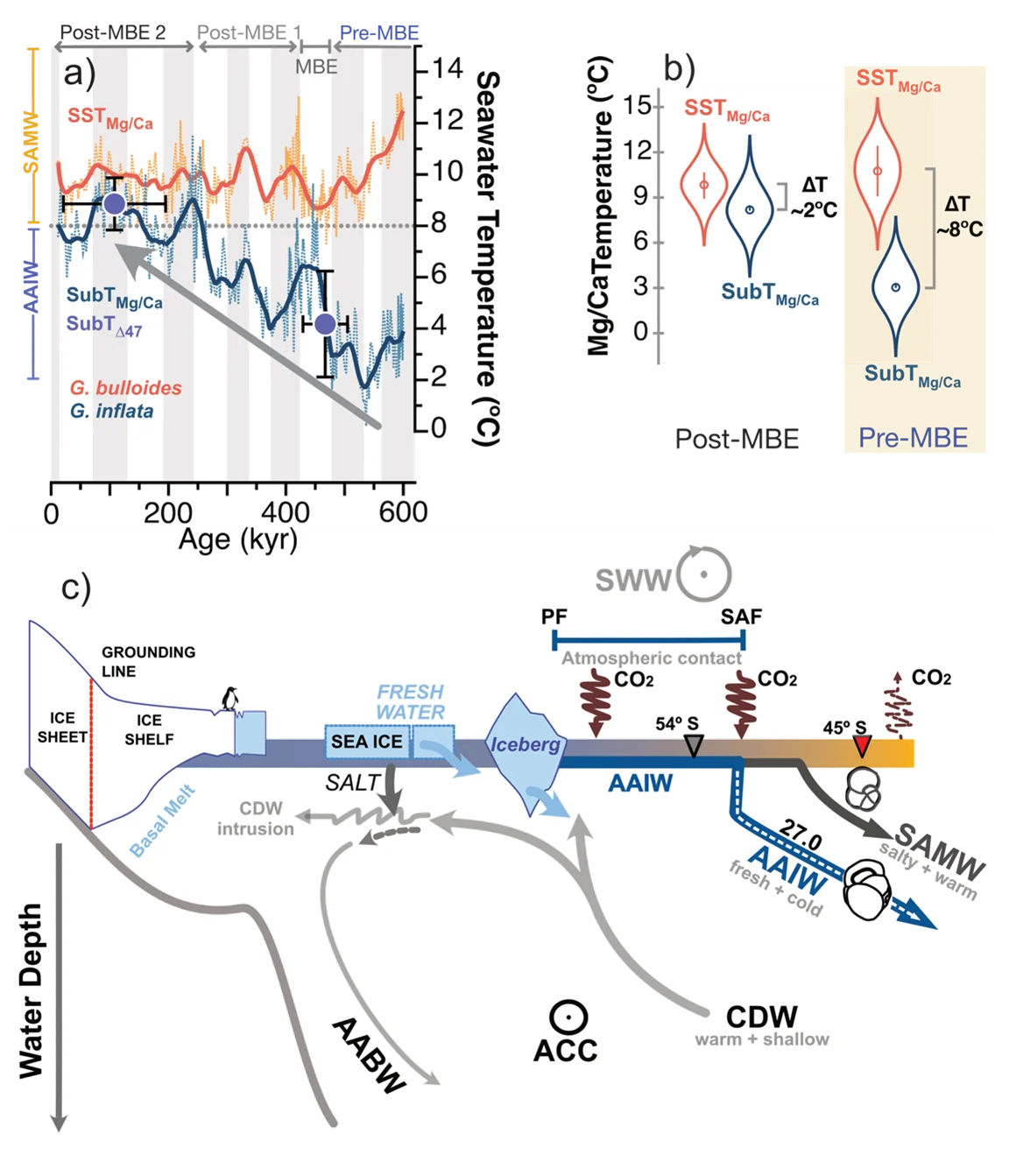
Their findings reveal a striking contrast on either side of the MBE (Fig. 1a, b). Before the MBE, AAIW was colder and fresher, enhancing its capacity to absorb more CO2 from the atmosphere. Strong ocean stratification helped lock that carbon away deep in the ocean interior. After the MBE, AAIW became warmer and saltier, reducing its CO2 uptake. Weaker stratification meant carbon could escape back to the atmosphere — coinciding directly with rising interglacial CO2 levels.
The iceberg connection
What made AAIW colder and fresher before the MBE? The researchers point to Antarctica’s icebergs (Fig. 1c). Proxy evidence indicates that, prior to the MBE, Antarctica discharged more icebergs than it does today. As these icebergs drifted northward and melted, they delivered large volumes of freshwater into the AAIW formation zone. A stronger Antarctic Circumpolar Current (ACC) — estimated to have been 130–150% more vigorous than today — amplified this effect by transporting icebergs and their meltwater farther north.
Together, these processes cooled and freshened the intermediate water, dramatically boosting its ability to draw down atmospheric CO2. After the MBE, a southward shift in the Southern Westerly Winds reduced upwelling of warm Circumpolar Deep Water onto Antarctic continental shelves, limiting ice-shelf melting and iceberg calving. A weaker ACC transported less freshwater northward. The result: warmer, saltier intermediate water with a diminished appetite for CO2.
Why it matters
Understanding the mechanisms that controlled atmospheric CO2 concentration in the past is key to predicting future change. This study challenges the long-held idea that only the deep ocean drove major CO2 shifts, showing that mid-depth waters played a crucial–and largely overlooked–role.
The research also uncovers a surprising link between CO2 and Antarctic ice melt and iceberg activity. In future, as Antarctic ice loss accelerates, the ocean may become less effective at locking away carbon–potentially amplifying future warming under high carbon emission.
"We tend to think of the deep ocean as the driver of past CO2 changes, but our data show that intermediate waters — forming just a few hundred meters below the surface — were quietly doing a tremendous amount of the work. When that capacity declined after the Mid-Brunhes Event, CO2 rose. That connection has been hiding in plain sight," says first and corresponding author Dr. Raúl Tapia.
Dr. Raúl Tapia 's email address: raultapia@ntu.edu.tw
Prof. Sze Ling Ho’s email address: slingho@ntu.edu.tw