
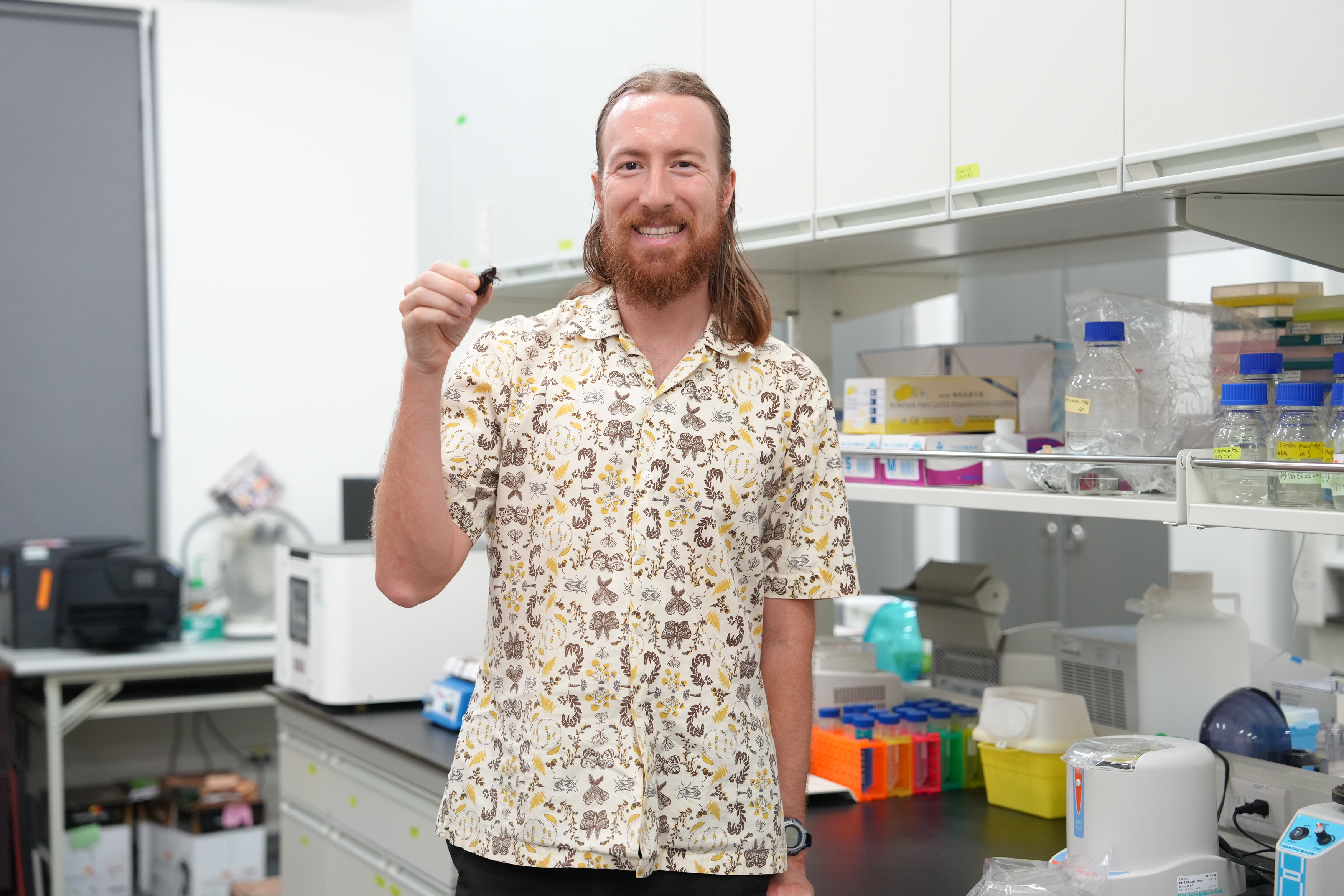
From ants in a New York apartment to insects living on the Antarctic ice; from Harvard and UC Davis to Germany Max Planck Institute for Chemical Ecology and, ultimately, National Taiwan University—Professor Matan Shelomi’s scientific journey spans half the globe. This international journey has profoundly shaped both his research perspective and his approach to teaching. Since joining NTU in 2017, Professor Shelomi has continued to open new directions in the field of insect microbiology, while building bridges between Taiwan and the wider world through international collaboration and cross-cultural education.
From New York to Taiwan: a journey shaped by insects
Professor Shelomi’s fascination with insects began in childhood. Growing up in New York City, with limited access to natural environments, he found inspiration instead in ants at home, books from the library, and nature documentaries on television. That curiosity led him to formal scientific training at Harvard University, followed by doctoral studies in entomology at the University of California, Davis, where he started his professional research career. During his PhD, Professor Shelomi undertook short-term research projects in Japan, Taiwan, and Indonesia. These experiences helped him develop both adaptability and a strong interest in working across cultural contexts. After completing his doctorate, he went to Max Planck Institute for Chemical Ecology in Germany for postdoctoral research, collaborating with teams across Europe and gradually building the broad international research network he maintains today.
Ultimately, he chose to settle in Taiwan. With a smile, he notes that he is now far from his family, but Taiwan offers a rare combination of everyday convenience, academic freedom, and stable research support—conditions that allow him to pursue his research ideals most effectively.

Laboratory structure and philosophy: autonomy, international perspective, and academic independence
In 2017, Professor Shelomi established the Insect Microbiology Laboratory at NTU. Unlike many large-scale biology labs, his team is intentionally small and focused, consisting of himself, one doctoral student, one master’s student, and a few interns. These interns come from countries such as Indonesia and Vietnam, giving the lab an inherently international character and making it an important entry point for international students interested in insect science.
Professor Shelomi describes his management approach as distinctly “American”: emphasising student autonomy, encouraging freedom in research topics, and avoiding excessive oversight. In his view, scientific research should be driven by curiosity and intrinsic motivation rather than by output metrics or hierarchical instruction. He hopes students can experience the same sense of choice and enjoyment in research that he himself had during his time at UC Davis.
He acknowledges that this style does not suit everyone, but believes it is particularly effective for students who are highly motivated and capable of working independently, as it creates the conditions in which creativity can flourish.

Research focus: from insect gut microbiomes to black soldier flies and the circular economy
Professor Shelomi’s research centres on interactions between insects and microorganisms. He investigates where insect gut microbes come from, how they survive, the roles they play in host evolution, and why different insect species vary in their dependence on microbial partners. These questions span ecology, microbiology, and co-evolution, forming the theoretical foundation of his work.
In recent years, his attention has increasingly turned to the black soldier fly. The larvae of this species can rapidly break down food waste and other organic materials, converting them into high-protein biomass suitable for animal feed, including poultry, fish, and shrimp. This process of transforming waste into protein has positioned the black soldier fly as a key species within the global circular economy.
Beyond studying the insect’s physiology, Professor Shelomi brings his expertise in gut microbiomes into this field, seeking to understand whether microbes can enhance nutrient absorption and waste-conversion efficiency. He also engages directly with Taiwan’s black soldier fly industry, visiting private facilities and incorporating these real-world insights into his teaching at NTU.
For Professor Shelomi, the black soldier fly offers an ideal pathway from fundamental research to practical application. The species directly addresses Sustainable Development Goals such as responsible consumption and production, climate action, and sustainable agriculture and aquaculture, while providing tangible sustainability solutions for Taiwan and beyond.

International collaboration: from NTU Joint Seed Funding to transcontinental research in Antarctica
International mobility has shaped Professor Shelomi’s career, and his research at NTU remains deeply global in orientation. Through Joint Seed Funding from NTU’s Office of International Affairs, he has established collaborations with Prof. Shai Meiri of the Faculty of Life Sciences at Tel Aviv University. Through the UAAT International Young Visiting Scholar Program, he conducted an exchange program with Prof. Jeff Tomberlin of Texas A&M University. He has also facilitated an internship for an NTU student at Professor Jeff Tomberlin’s laboratory, which is the largest Black Soldier Fly (BSF) research center in the United States.; that student has since gone on to pursue a related master’s degree at the University of Turin in Italy, exemplifying NTU’s international reach.
Furthermore, Professor Shelomi has delivered lectures on 'Insect Farming and the Circular Bioeconomy: Interdisciplinary Opportunities for the Pacific Islands' across research institutions in Fiji, the Solomon Islands, the Marshall Islands, Guam, the Northern Mariana Islands, Samoa, and the Cook Islands. Additionally, he collaborated with graduate students from the Indonesia International Institute for Life Sciences on small-scale Black Soldier Fly trials, and actively pursued joint projects with partners in the United Kingdom and Australia. While not all proposals have yet been approved, he describes his approach simply: applying whenever opportunities arise and steadily expanding his global network.
Among his most distinctive projects is a collaboration with the Vernadsky Research Base in Ukraine to study the gut microbiome of the Antarctic midge—the continent’s only endemic insect species. This work took Professor Shelomi to Antarctica itself, symbolising the extension of insect microbiology research into one of the world’s most extreme environments.
Teaching impact: from NTU to the world through Coursera
Alongside research, Professor Shelomi’s teaching is equally international in scope. His general education course on edible insects is among the most popular at NTU, enrolling around 250 students each semester. The course spans cultural, environmental, sustainability, legal, food-technology, and industry perspectives.
What distinguishes the course is its genuinely global outlook. Students explore insect-eating cultures from around the world, while examining regulatory frameworks, food-industry trends, and sustainability challenges across different countries. Many come away with a more open attitude toward unfamiliar foods and a deeper understanding of how cultural context shapes perceptions of what is considered “normal” to eat.

To reach a wider audience, Professor Shelomi adapted the course for Coursera, bringing NTU’s teaching to learners worldwide. This contribution earned him the Entomological Society of America’s 2024 Science Communication Award, recognizing his efforts to extend education beyond the campus.
The Taiwan experience: research freedom, quality of life, and advice
Asked why he chose to remain in Taiwan, Professor Shelomi’s answer is straightforward: quality of life combined with research freedom. He describes Taiwan as safe, convenient, and well connected, with excellent food and a strong research-funding system that allows scholars to pursue academic work without excessive competition. Compared with many countries, Taiwan’s research environment enables him to focus on intellectual interests rather than constant resource pressures.
While administrative processes are primarily conducted in Chinese, Professor Shelomi has found Taiwan highly supportive of international faculty, with digital tools and collegial assistance making day-to-day administration straightforward. Some basic Chinese can be helpful, he notes, while international students interested in English-taught programmes are encouraged to confirm course offerings in advance. For short-term exchanges, Taiwan remains an especially welcoming and accessible destination.
From insect gut microbiomes to black soldier fly circular economies, from Tel Aviv and Texas to Antarctic research stations, Professor Shelomi has woven his experiences of global mobility, academic freedom, and international collaboration into NTU’s research and teaching. His laboratory may be small, but its international and cross-cultural perspective has secured it a visible place within global entomology and sustainability research.