
Climate change is reshaping the world’s oceans, with coral reefs—key ecosystems for marine biodiversity—among the most directly affected. Rising sea temperatures, changing typhoon patterns, and expanding coastal development are altering reef structure, species composition, and ecological function across many regions.
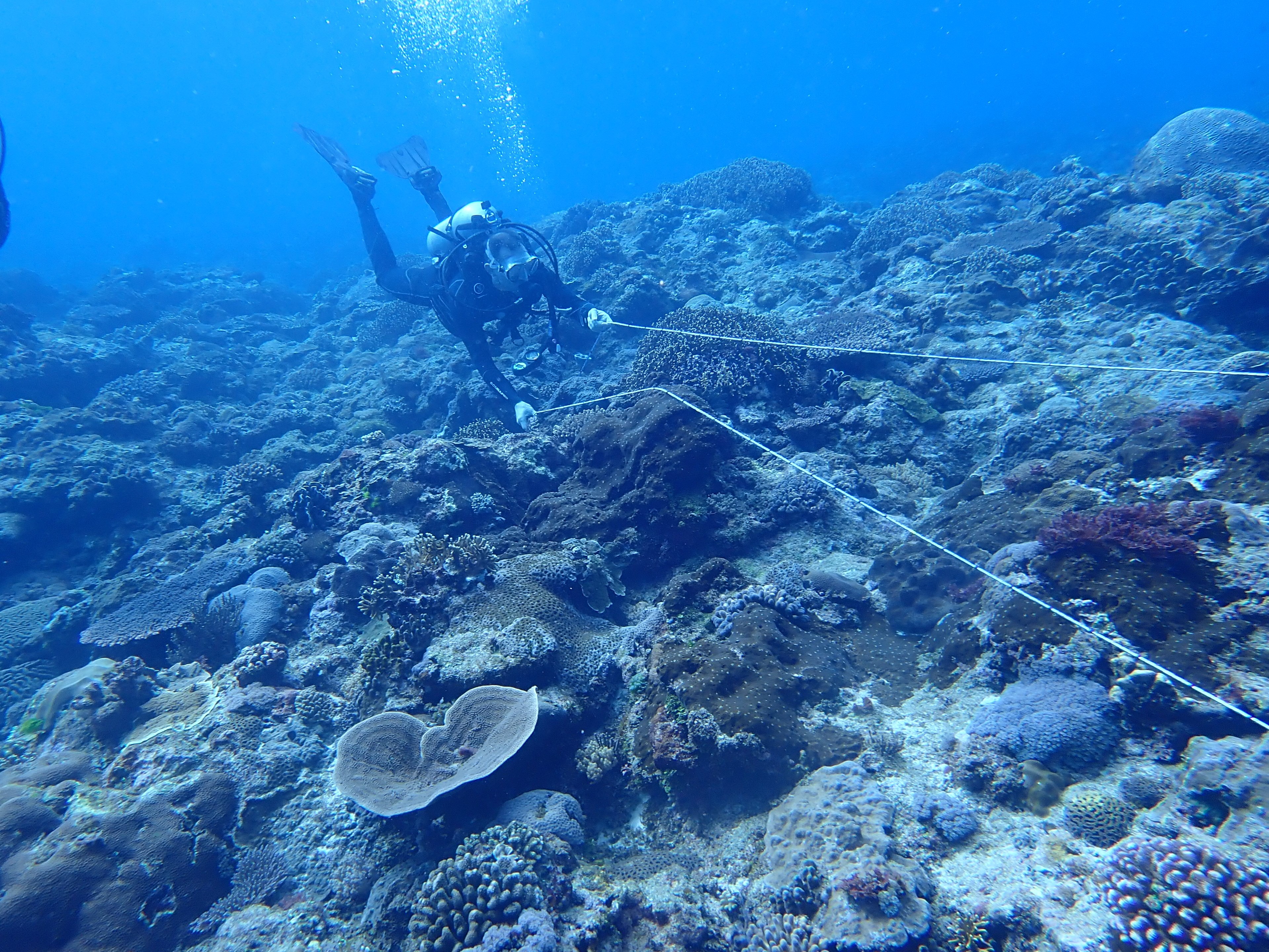
At National Taiwan University, the Functional Reef Ecology Lab, led by Associate Professor Vianney Denis, investigates these questions across depths, species, and environments. The team combines long-term diving surveys, remotely operated vehicle (ROV) exploration, and physiological and molecular analyses to understand how corals and their associated organisms respond to change—from heatwave-driven bleaching in shallow waters just five metres deep to the possibility of ecological refuges more than a hundred metres below the surface. Their work documents ecological change in Taiwan’s seas while offering broader insights into what future oceans may look like.
Exploring Coral Reef Ecosystems Amid Environmental Change
Taiwan as a natural laboratory: how corals respond to environmental change
Taiwan’s marine environments vary sharply from south to north. Differences in temperature, currents, seafloor topography, and human pressures can shape reef communities in markedly different ways, making the island’s surrounding waters a natural laboratory for studying how climate change and local impacts interact.
The lab builds on these contrasts through sustained surveys across multiple regions, tracking bleaching, mortality, and recovery to understand why some species decline rapidly under extreme conditions while others remain comparatively tolerant. Xiaoliuqiu provides a striking example. Coral cover was still high in the 1970s, but today it has fallen to around 4%, with the ecosystem shifting from coral dominance to algal proliferation. By combining historical records with present-day field observations, the team analyses the drivers behind such rapid transitions.
The lab also tracks the possibility of poleward shifts in species distributions. As waters warm year by year, some corals formerly restricted to tropical latitudes may begin establishing populations farther north, while more sensitive species may retreat or disappear from southern sites. Through north–south comparisons and long-term monitoring, the researchers aim to map how coral distributions around Taiwan could change—and how those shifts may alter the composition of reef ecosystems.
Beyond the shallows: what deep-water refuges really look like
Most coral reef studies focus on depths of five to ten metres. In Taiwan, however, steep underwater terrain—particularly along the east coast and around offshore islands such as Green Island—extends coral habitat much deeper. Associate Professor Denis notes that corals can still be found at 70–80 metres, and may extend to around 120 metres or beyond. Yet ecological data from these depths remain limited.
To address this gap, the lab uses ROVs to collect imagery and ecological records in deeper zones, asking whether these environments could function as refuges when shallow reefs face intense heat stress or coastal pressures. If shallow communities experience widespread mortality during heatwaves or pollution events, deeper habitats—warming more slowly and experiencing different forms of disturbance—may allow some species to persist, potentially supporting recovery in shallower areas over time.
This work helps clarify the role deep-water corals may play in conservation and recovery, and it may also reshape how scientists understand vertical connectivity within reef ecosystems.

Looking within species: from “averages” to individual differences
Comparing different species is not enough to anticipate how reefs will change. Another central focus of the lab is variation within a species—differences among individuals that can determine whether populations endure under stress.
Most studies treat “species” as the unit of analysis, but Denis emphasises that survival often depends on internal diversity. If individuals of the same species differ substantially in their responses to temperature, light, or pollution, the more tolerant individuals may form the basis of future populations—providing the raw material on which natural selection can act.
Through individual-level physiological measurements, comparisons of environmental responses, and long-term monitoring, the lab examines how much variation exists within a species and what that means for its prospects under future conditions.
Teaching and Lab Culture: learning through dialogue and renewal
Denis is clear that he does not want teaching to become one-way transmission. His long-running course on coral ecology reflects that approach. This year, the class included around 70% international students and 30% Taiwanese students. After a two-and-a-half-hour session, discussion continue for more than an hour, with students staying to ask questions and debate ideas.
He revises his teaching materials each year to reflect current research rather than relying on static slide decks. Not every instructor has the time to do this, he acknowledges, but he believes students can tell immediately whether a course stays current—and that is why he continues to invest in updates.

Alongside ecology, he also teaches an introductory course in R for students with no programming background. Many new graduate students, he observes, have avoided statistics or coding earlier in their studies, only to discover that ecological research makes these skills unavoidable. The course begins with fundamentals—installing software and setting up an environment—then moves into practical workflows including GitHub, data processing, and automated reporting. The aim is not only to teach tools, but to reduce anxiety and build enough confidence for students to explore more advanced methods independently. The course is frequently fully enrolled, reflecting strong student demand.
In day-to-day mentoring, he also notices differences in classroom culture. Taiwanese students, he says, are often diligent and well prepared, but may hesitate to speak; American students may be more willing to contribute in class, though sometimes less focused outside it. In his view, the main barrier for many Taiwanese students is not English ability but limited opportunities—and confidence—to use English in real settings. An international lab environment helps create that setting. When students say, “My English isn’t good,” he replies, “My Chinese isn’t either—so don’t worry.” Over time, many begin communicating naturally in English and show greater confidence in presentations, discussions, and welcoming visiting scholars.
This teaching philosophy shapes the lab culture as well. While the group was once much larger—approaching twenty members—it has since been streamlined ahead of his sabbatical into a smaller, more focused team. The core principles remain the same: an open, international space that values discussion and encourages students to try, learn, and make mistakes. He sees this as essential for developing not only technical ability but independent thinking and a sense of voice in research and collaboration.
International collaboration across diverse seas
Denis’s collaborations span East Asia and Europe, combining joint dives, fieldwork, and research projects across contrasting marine environments.
In Korea, partnerships that began during his postdoctoral period have focused in particular on Jeju, where warming seas have driven visible changes in underwater landscapes over a relatively short period. Although Jeju does not have a dedicated marine station, collaboration with local researchers—supported by resources such as dive operators—has made the region a valuable site for observing rapid ecological change and possible poleward shifts.
In Japan, he maintains close ties with prof. Yoko Nozawa, who based at Sesoko Marine Research Station, Tropical Biosphere Research Center, University of the Ryukyus. He previously worked at Academia Sinica. Their partnership continues through small-scale projects and shared fieldwork. The university’s Sesoko Station offers strong infrastructure—labs, boats, seawater tanks, and immediate access to the water—making it well suited to efficient, field-based collaboration.
His European network is equally active. During his previous sabbatical, he visited the Scientific Center of Monaco to discuss plans to use stable isotope analysis to study coral feeding. He also travelled to the Banyuls Oceanographic Observatory in southwestern France, working with a collaborator capable of diving to depths of around one hundred metres. Together they revised a proposal examining how water flow influences the structure of marine animal forests. He is also involved in the European Cooperation in Science and Technology(COST) programme, a cross-border networking platform focused on the degradation and functioning of marine animal forests. While major projects such as Biodiversa+ could be highly competitive and difficult to apply, he continues to build collaboration pathways across countries, using comparative work across regions to deepen research questions and bring wider perspectives into Taiwan’s marine research community.
Reflecting on his experience living and working in Taiwan, Denis says he genuinely enjoys it. Having lived and worked in several Asian countries, he considers Taiwan the best overall fit. He describes Taiwanese society as safe and welcoming, with an openness that enables international scholars to focus on their work. Through his research and teaching, he hopes to contribute to a more resilient future for Taiwan’s marine environments.