

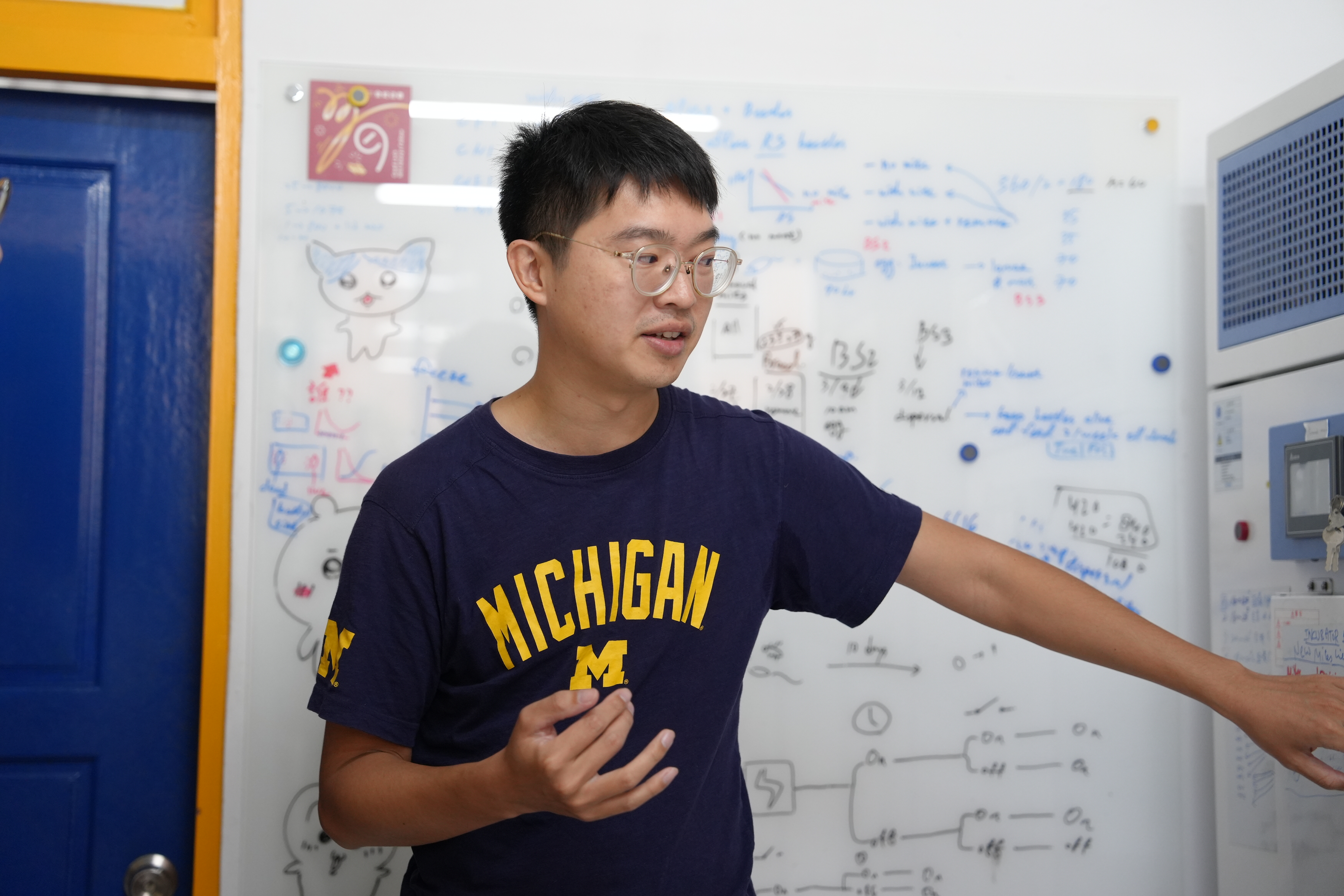
 A Passion for the Burying Beetle: The Origin of a Research Journey
When discussing environmental change, many people think of carbon emissions from industrial activities or the impact of rising temperatures on humans and animals. Professor Syuan-Jyun Sun, however, approaches the topic from a more microscopic angle. By focusing on the burying beetle in his research, he explores how environmental change affects insects and how species interactions shift in response—revealing ecological impacts at a broader systemic level.
Professor Sun graduated from the Department of Plant Pathology and Microbiology at National Taiwan University and went on to pursue his master’s degree at NTU’s Department of Entomology. Under the guidance of Prof. Ping-Shih Yang and Academician Shen Sheng‐Feng at Academia Sinica, he began his evolutionary ecology research using burying beetles as a model system, establishing a long-lasting academic connection with the insect. During his PhD at the University of Cambridge, he continued to work with burying beetles while expanding his research to include their interactions with other species. Following his doctoral training, he returned to Taiwan to establish his own laboratory within the NTU International Degree Program (IPCS) in Climate Change and Sustainable Development, contributing his expertise in ecological and evolutionary sciences.


The laboratory currently includes Prof. Sun, two postdoctoral researchers, two full-time research assistants, and five graduate students, with undergraduate students joining during the summer. As IPCS is an international program, lab members come from Taiwan, India, the Philippines, Canada, France, and beyond—reflecting the lab’s strong appetite for international collaboration.


Using Burying Beetles as a Window into Environmental Change
The Sun Lab’s core research theme is species interactions and adaptation under environmental change.
Burying beetles play a unique ecological role making them an ideal focal organism for this work. As decomposers, burying beetles break down small vertebrate carcasses in forest ecosystems,returning their nutrients to the soil. Their abundance therefore reflects the richness and diversity of other organisms in the environment and indirectly indicates habitat suitability. Moreover, burying beetles exhibit parental care, an uncommon behavior among insects. They process carcasses into brood balls’, bury and use them to feed their larvae—an evolved strategy that enhances offspring survival. Because carcasses are a limited and valuable resource, burying beetles often form social groups to share and defend them, also offering opportunities to study cooperative and competitive behaviors. Their interactions extend beyond the beetles themselves, as burying beetles carry small hitchhiking mites that then feed on the eggs of competing flies. This mutualistic relationship shows how species collaborate when faced with environmental pressures. Given how closely these traits match the laboratory’s research focus, the burying beetle has emerged as the group’s core study organism.
Urbanization, the Urban Heat Island Effect, and Burying Beetle Populations
A recent collaboration between the Sun Lab and the National Science and Technology Council focused on how urbanization and the urban ‘heat island’ effect impact burying beetles. From May to November—peak beetle activity season—the team collected samples across more than 180 sites in northern Taiwan. They also installed sensors at each sampling location to record air and soil temperatures every 15 minutes, creating a continuous and detailed dataset of microclimatic variation. The lab also works with Prof. Chung, Ming-Kuang, an expert in Geographic Information Systems, who provides high-resolution land-use data for northern Taiwan. Integrating beetle samples, temperature records, and land-use patterns allows the lab to examine how changes in forest cover and urban heat influence beetle distribution.
The results show that areas with higher forest cover support larger beetle populations. Conversely, places with stronger urban heat-island effects tend to have fewer beetles.Since burying beetles rely on vertebrate carcasses, their population size also reflects the overall biomass and biodiversity of the area. Thus, reduced forest cover, fragmented habitats, and rising urban temperatures collectively decrease beetle numbers—and by extension, the diversity of other organisms. These insights should be taken into account in urban planning and serve as a warning for future urban development.
Parental Care, Warming, and Cross-Species Cooperation
Another major research focus—recently published in “Proceedings of the Royal Society B”—examines how parental care helps burying beetles cope with warming and heat stress.
As noted earlier, burying beetles display rare parental care behavior among insects. The study investigates whether this behavior can protect larvae from the effects of warming and results show that parental care does offer protection during the earliest and most vulnerable life stages, particularly before and shortly after hatching. However, when larvae experience high temperatures throughout their development, the advantages of parental care rapidly diminish; warming still exerts significant negative effects.

The study also highlights the closely tied relationship between burying beetles and phoretic mites. Just like burying beetles, phoretic mites also depend upon carcasses to breed; but unlike beetles, mites can’t find a carcass themselves. Instead, mites hitch a ride on the beetles for transportation among carcasses. This alignment illustrates a sophisticated interspecies interaction.


International Collaboration: Shared Perspectives Across Time Zones
Prof. Sun’s research spans behavioral ecology, urban ecology, and species interactions, and consequently relies heavily on international collaboration. These partnerships develop organically, grounded in shared scientific curiosity.
In the UK, his long-term collaboration with Dr. Benjamin Jarrett in Bangor University stems from their time together at Cambridge. Dr. Jarrett’s broad expertise in parental care across multiple species provides valuable insight into the Sun Lab’s beetle-focused studies. Their discussions—ranging from experimental design to hypothesis development and data interpretation—reflect complementary research environments in Taiwan and the UK.
Another collaboration emerged from a literature review, when Prof. Sun contacted Prof. Thomas Merckx at Vrije Universiteit Brussel after reading his work on how European urbanisation affects insects.three years, they exchanged ideas across time zones exclusively by email, developing a model linking urban heat island effects to habitat connectivity—before ever meeting in person. They eventually met at an international conference, completed a manuscript within two weeks, and strengthened their collaboration. For Prof. Sun, this represents the ideal scientific partnership. He said, ‘You send a message in the morning, they reply at night, and the next day you can continue the work.’
In Taiwan, his collaboration with Prof. Chung further expands the research landscape. Long-term land-use datasets—spanning nearly a century—enable the lab to examine how habitat structure influences beetle populations under urbanization.
Cross-Disciplinary Inspiration: Ideas Sparked Over a Cup of Tea
When reflecting on how interdisciplinary exchange is encouraged, Prof. Sun often recalls a distinctly British ritual at Cambridge: Tea Time.
At 10:30 a.m. and 3 p.m. every day, lab members and scholars across the department would pause their work, gather in a common area, drink tea, enjoy snacks, and talk. These were not formal meetings but relaxed conversations where behavioral ecologists, biomechanics students, physicists, and geneticists might share the same table.
In one of these informal chats, a conversation with a biomechanics doctoral student led to a collaboration to study how phoretic mites attach to burying beetles. The student specialized in how arachnids adhere to various surfaces—knowledge that directly applied to understanding how wingless mites hitch rides on beetles with remarkable precision. A simple conversation opened the door to a new cross-disciplinary approach.
Back in Taiwan, Prof. Sun continues to cultivate similar spaces despite limited room. Through workshops, visiting scholar interactions, and informal discussions with students, he encourages cross-disciplinary thinking as a daily practice rather than an occasional event.
Outreach and Social Impact: Bringing Science Into Everyday Life
Prof. Sun participates in science outreach initiatives, gives public talks, teaches in high schools, and contributes to public science communication through interviews and media features. He also collaborated with an international film makers to produce a macro-biology documentary, 《This Mite-y Beetle Buries the Dead to Start a Family | Deep Look》, which has garnered 1.45 million views so far—showing how ecological science can resonate with a wide audience.
Throughout the interview, Prof. Sun repeatedly emphasized the importance of collaboration. From mutualistic relationships between beetles and mites to the cooperative dynamics within a forest ecosystem, nature demonstrates resilience built through interaction. These insights inform how humans should respond to climate change: effective solutions require cross-sector and cross-disciplinary cooperation across research, policy, sustainability action, and public engagement.
These observations also shape how he views humanity’s response to climate change. Whether in scientific research, sustainability policy, corporate climate action, or public engagement, meaningful progress depends on collaboration across disciplines, sectors, and perspectives.
It is this conviction that led Prof. Sun to join NTU’s International Degree Program in Climate Change and Sustainable Development. The program’s openness to interdisciplinary inquiry and its flexibility in accommodating diverse research questions allow him to extend ecological and evolutionary research toward broader sustainability challenges—linking fundamental science with real-world environmental change.
More about the Sun Lab: https://labspotlight.ntu.edu.tw/labs/106
Official Website of Sun Lab: https://sites.google.com/view/sjsun/home
More about NTU Lab Spotlight: https://labspotlight.ntu.edu.tw/