

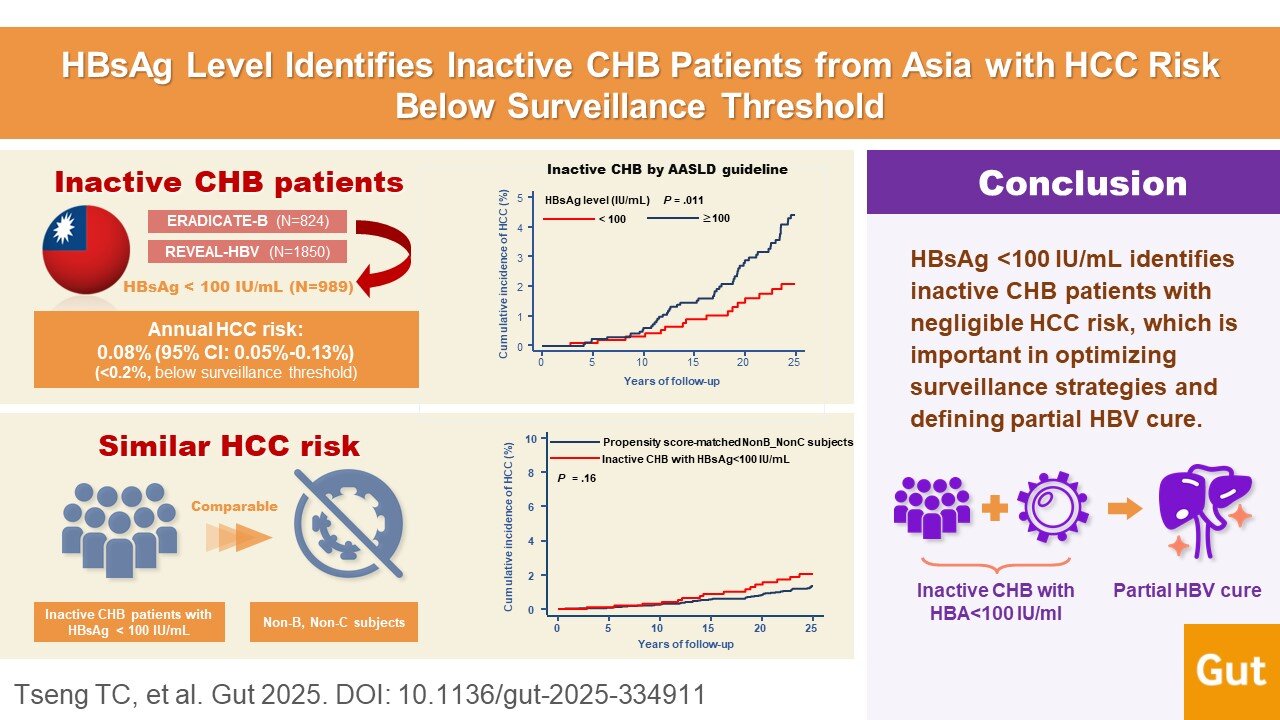
Researchers from National Taiwan University Hospital and Academia Sinica have identified a simple blood marker that can reliably pinpoint chronic hepatitis B (CHB) patients at negligible risk of developing liver cancer.
The study, published in Gut, shows that patients with hepatitis B surface antigen (HBsAg) levels below 100 IU/mL face an annual hepatocellular carcinoma (HCC) risk of only 0.08%, comparable to the general population.
The findings come from two of the world's largest HBV cohorts, ERADICATE-B and REVEAL-HBV, with more than 2,600 inactive CHB patients followed for over 25 years. Validation in the NTUH-iMD cohort confirmed that the low-risk threshold applies broadly.
Notably, about one-third (37%) of inactive CHB patients had HBsAg <100 IU/mL, meaning that millions worldwide may fall into this ultra-low-risk category.
"HBsAg <100 IU/mL identifies patients with what we call a 'partial cure' of hepatitis B," said Doctor Tai-Chung Tseng, lead author. "These patients may no longer need routine liver cancer surveillance, which could transform public health strategies."
Globally, 254 million people live with CHB, and over 1 million die annually, mainly from HCC. Current surveillance protocols are costly and often burdensome, especially in resource-limited settings. By adopting HBsAg <100 IU/mL as a benchmark for partial cure, clinicians may reduce surveillance in low-risk patients while focusing resources on those at higher risk.
The authors emphasize that this threshold could also serve as a practical endpoint for upcoming HBV cure trials, bridging the gap between current antiviral therapy and functional cure.