

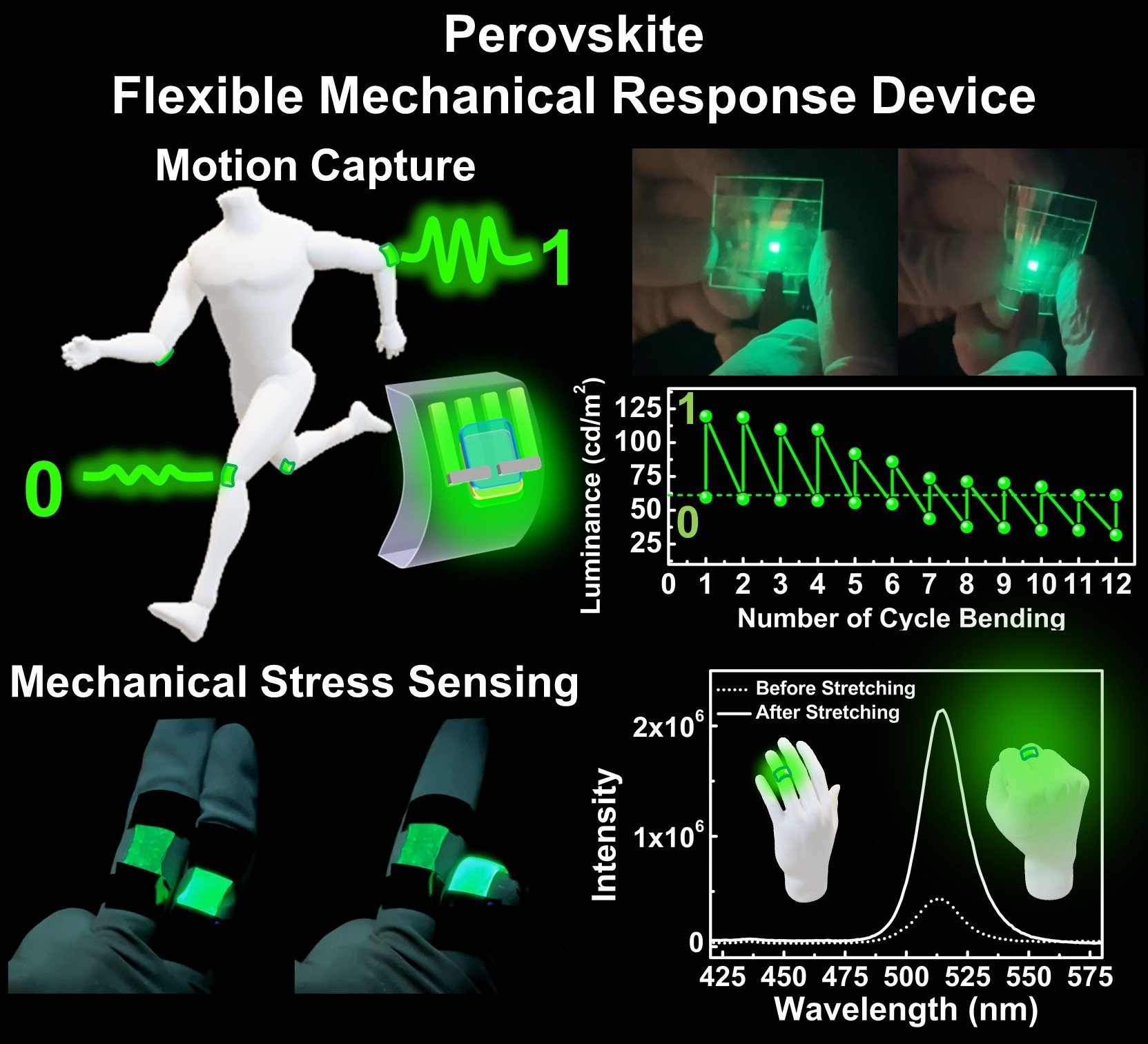
A research team led by Prof. Ru-Jong Jeng from the Institute of Polymer Science and Engineering at National Taiwan University, in collaboration with Prof. Chi-Ching Kuo's team from the Institute of Organic and Polymeric Materials at National Taipei University of Technology, has developed a flexible mechanical response device (FMRD) utilizing perovskite–polymer composites. Their findings were recently published in Advanced Science.
The FMRD device incorporates a high-crystallinity ester polymer, specifically Poly(ε-caprolactone) (hc-ester), alongside perovskite to influence crystallization through ion-dipole interactions. This approach creates a phenomenon known as “crystallized space confinement”, which minimizes sub-dimensional crystal domains and enhances exciton transfer efficiency. Consequently, the device exhibits stronger luminescence, a lower trap density, and improved spectral stability.
In practical applications, the flexible mechanical response device (FMRD) demonstrates distinct optical reactions to mechanical deformation. When bent, the device exhibits an increase in luminance, a 2 nm blue shift, and improved external quantum efficiency (EQE). When stretched, the emission spectrum changes in a predictable RGB pattern, which allows for machine-learning-based classification of strain levels.
These characteristics enable the FMRD to function as both a motion capture light source and a mechanical stress sensor, making it highly relevant for next-generation wearable and interactive electronics.
“This study highlights how synergistic crystallization between polymers and perovskites can transform flexible devices into intelligent optical logic systems,” said Prof. Ru-Jong Jeng.
“Our findings open up exciting opportunities for advanced motion capture, human–computer interaction, and next-generation smart sensing technologies,” added Prof. Chi-Ching Kuo.
This research article, “Flexible Mechanical Response Device With Optical Logic Emission Enabled by Synergistic Crystallization Engineering of Ester Polymer and Perovskite”, was published in Advanced Science in August 2025 (DOI: 10.1002/advs.202508812).
Prof. Chi-Ching Kuo’s email address: kuocc@mail.ntut.edu.tw
Prof. Ru-Jong Jeng’s email address: rujong@ntu.edu.tw