

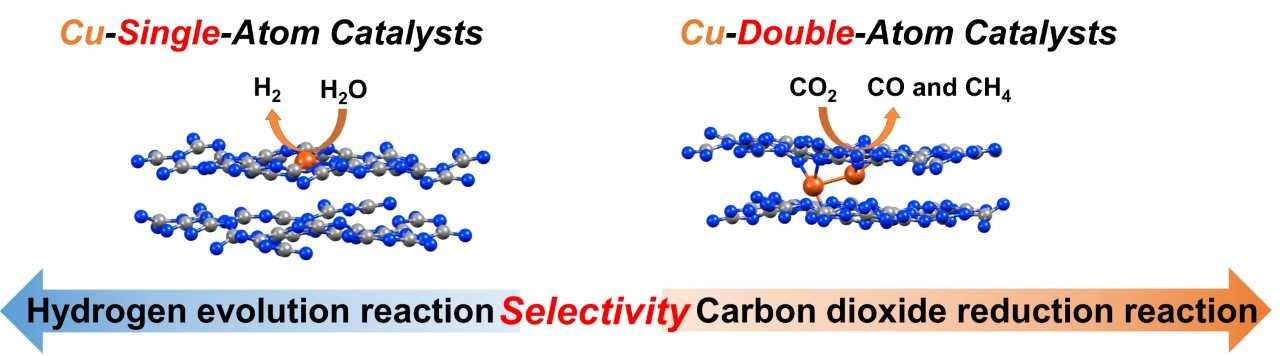
Scientists have discovered a way to control chemical reactions by carefully arranging copper atoms on a carbon-based material. With just tiny changes at the atomic scale, the same material can be switched to produce either hydrogen or methane from simple starting ingredients.
In a study published in Advanced Functional Materials, a collaborative team from the National Synchrotron Radiation Research Center in Taiwan (experimental group) and the Center for Condensed Matter Sciences, National Taiwan University (theoretical/computational group), demonstrated how atomic-scale engineering of copper on graphitic carbon nitride (g-C₃N₄) can control chemical reactions.
The researchers found that copper atoms placed individually or in clusters on g-C₃N₄ predominantly catalyze hydrogen evolution. In contrast, pairs of copper atoms embedded within g-C₃N₄ selectively convert carbon dioxide into methane, achieving an efficiency of 88%. This high selectivity not only makes methane production practical but also highlights a promising route for clean energy applications.
The findings reveal that even subtle differences in atomic arrangement can dramatically alter catalytic behavior. By precisely tuning the positions of copper atoms, it becomes possible to direct the reaction toward desired products, illustrating the power of atom-level control in material design.
"This study shows the potential of atomic design," says Michitoshi Hayashi, the study's corresponding author. "By simply changing where the copper atoms are positioned, we can guide the reaction along the pathway we want, enabling precise control over chemical transformations."
The work emphasizes the broader implications of atom-by-atom engineering, providing insights that could accelerate the development of next-generation catalysts and materials for sustainable energy. By leveraging such precise structural control, researchers aim to design catalysts that efficiently produce fuels and chemicals, ultimately reducing dependence on fossil resources while advancing clean energy technologies.
More information: Wan‐Ting Chen et al, Highly Selective Toward HER or CO2RR by Regulating Cu Single and Dual Atoms on g‐C3N4, Advanced Functional Materials (2025). DOI: 10.1002/adfm.202514183
Journal information: Advanced Functional Materials