
Understanding how quickly ice sheets can collapse is among the most urgent questions in climate science—and the geological past offers the only real-world test cases. An international research team led by Professor Chuan-Chou Shen of the Department of Geosciences at National Taiwan University (NTU) has now reconstructed the mechanism behind the most extreme warming and sea level rise event of the past million years. Published in Nature Communications in June 2026 and selected by editors as a Featured Article, the study shows that the weakening and subsequent recovery of the Atlantic Meridional Overturning Circulation (AMOC) drove a large-scale redistribution of heat within the ocean, triggering rapid ice shelf melting and abrupt sea level rise.
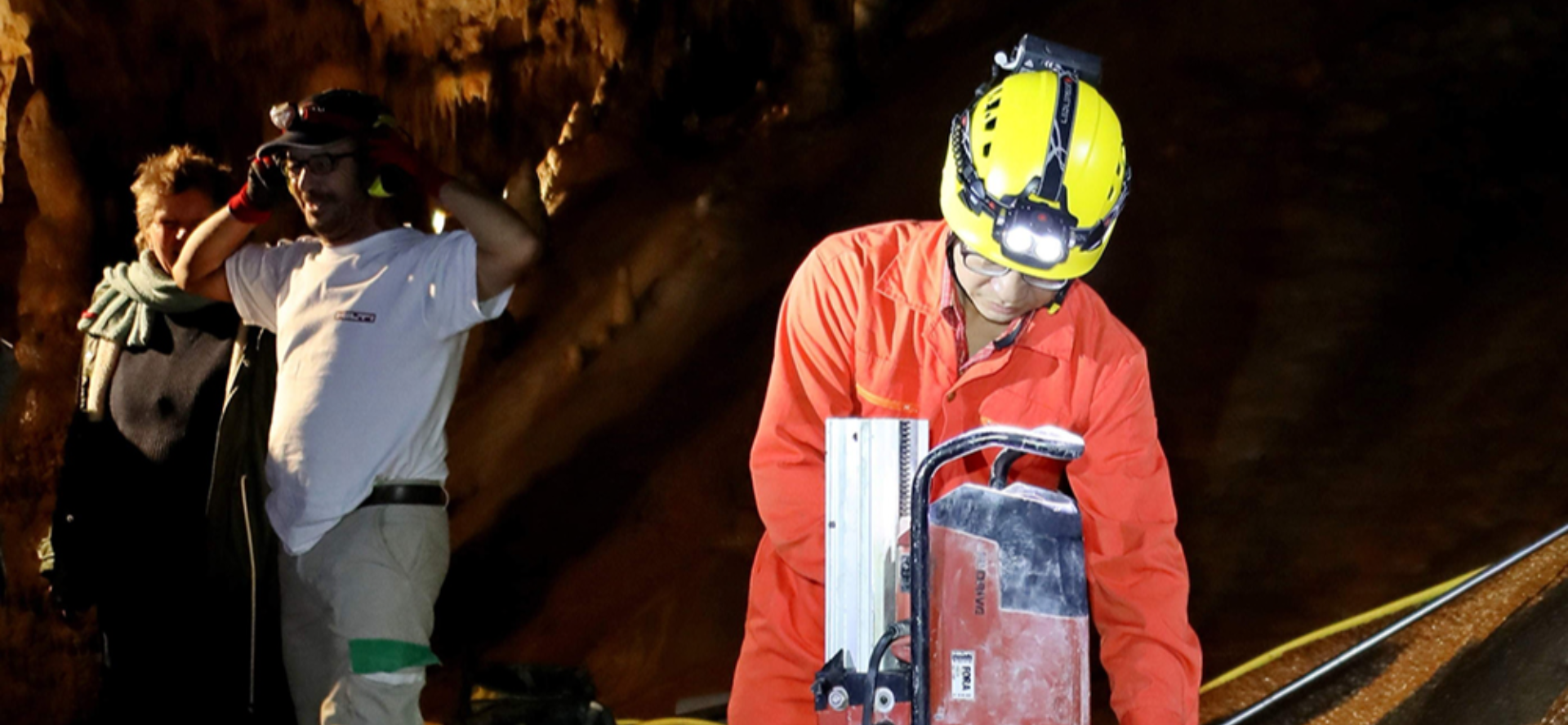
The team focused on Termination IV, a deglaciation roughly 340,000 years ago during which sea levels rose by as much as five meters per century—orders of magnitude faster than today's rate of a few millimeters per year. Previous research had struggled to establish causality because marine sediment records lacked precise absolute dating. Beginning in 2012, the team conducted repeated fieldwork at Bàsura Cave in northern Italy, drilling flowstone cores and applying high-precision uranium-thorium dating at NTU's HISPEC laboratory to build an independently dated hydroclimate record of the European westerlies. Integrating this framework with North Atlantic sediment records allowed the first precise reconstruction of the sequence linking circulation change, ocean warming, and sea level rise. The team established a chronology for five termination events across 440,000 years, finding that AMOC weakened for approximately 13,000 years during Termination IV—the longest such interval on record—trapping enormous heat in the deep ocean before releasing it toward polar regions.
The implication is that oceans do not merely store heat passively but actively regulate ice sheet stability through circulation. Professor Shen notes that while conditions 340,000 years ago cannot be mapped directly onto the present, the finding matters because the Greenland and Antarctic ice sheets are currently shrinking, and whether AMOC weakens or reorganizes will be decisive for future projections. Should deep ocean heat again be delivered rapidly beneath ice shelves, sea level rise may prove abrupt rather than gradual. Completed by more than 15 institutions across Asia and Europe, with core laboratory work and manuscript preparation led by NTU graduate Dr. Hsun-Ming Hu, the study offers a stronger scientific basis for coastal and low-lying regions planning climate adaptation.