

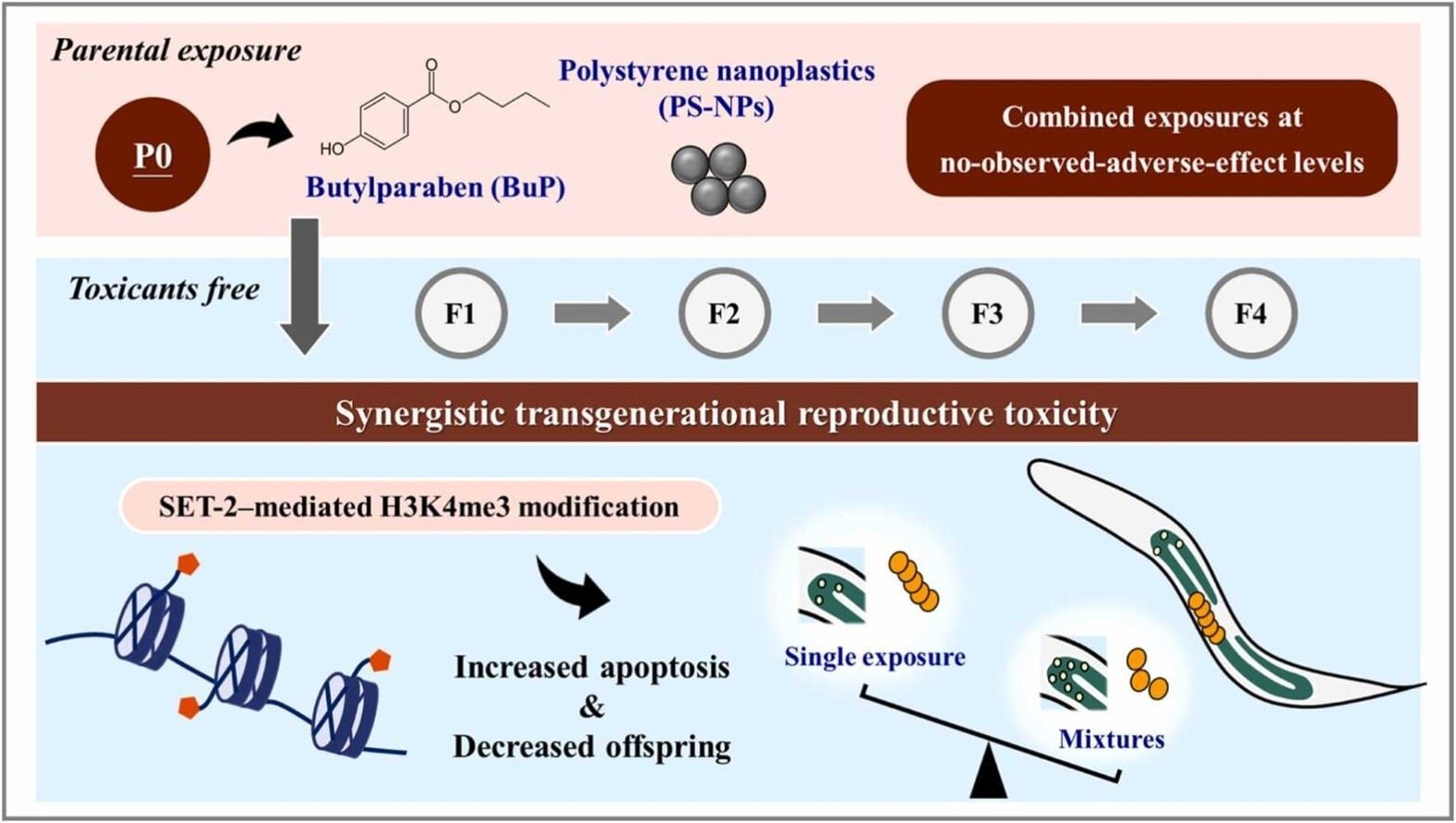
Researchers at National Taiwan University reveal that combined exposure to polystyrene nanoplastics and the preservative butylparaben, at a level considered safe on their own, can cause heritable harm, disrupting reproduction across generations through epigenetic changes.
Study reveals hidden risks of mixtures
Environmental pollutants are usually assessed one at a time, yet in natural environments they almost always occur as mixtures. A new study from National Taiwan University (NTU) shows that this gap in evaluation may hide important long-term risks to living organisms. The paper is published in the Journal of Hazardous Materials.
The researchers found that together, polystyrene nanoplastics and the widely-used preservative butylparaben can cause reproductive damage that persists across multiple generations, even when each substance is present at a level considered safe on its own.
Mechanisms behind transgenerational effects
The study focused on exposure levels known as no-observed-adverse-effect levels (NOAELs), which form the basis of many chemical safety standards. When tested individually at these concentrations, neither nanoplastics nor butylparaben caused measurable harm.
However, the results changed when the two contaminants were combined. Using the microscopic roundworm Caenorhabditis elegans as a model organism, the team observed a significant decline in reproductive output that lasted for up to four generations. These effects were detected even in descendants that had never been directly exposed to either chemical, indicating a heritable biological impact.
To understand how these effects were passed on, the researchers examined molecular changes in early embryos. They found that combined exposure increased oxidative stress in the parent generation and altered a key epigenetic marker known as histone H3K4 trimethylation. This modification, regulated by the enzyme SET-2, influences how gene activity patterns are inherited. When the SET-2 pathway was disrupted, the transgenerational reproductive effects disappeared, confirming that epigenetic regulation plays a central role in transmitting damage across generations.
Implications for environmental safety standards
"Our findings show that chemical safety assessments based on single substances may underestimate real environmental risks posed by the complex mixtures humans encounter daily," said Distinguished Professor Vivian Hsiu Chuan Liao (Department of Bioenvironmental Systems Engineering, NTU), corresponding author of the study. "Low-dose mixtures can interact in unexpected ways and leave effects that persist long after exposure has ended."
Polystyrene nanoplastics and butylparaben are commonly detected together in wastewater effluents and surface waters. The study highlights the need to incorporate mixture effects and long-term biological outcomes into environmental risk evaluation to better protect ecosystems and future generations globally.
To see article on Phys.org: https://phys.org/news/2026-01-effect-isnt-safe-chemicals-toxic.html