

Researchers at National Taiwan University have proposed a novel method to predict the onset of lithium metal formation—an internal battery response—during fast charging, using only external voltage measurements from commercial lithium-ion cells.
Fast charging of lithium-ion batteries (LIBs) can induce lithium metal deposition on the anode, commonly referred to as lithium plating, which not only degrades battery capacity but also elevates the risk of internal short circuits and associated safety hazards. However, identifying the onset of lithium plating using only full-cell data from commercial LIBs, without cell disassembly, remains challenging.
In a study published in Energy Storage Materials, researchers at National Taiwan University report a new method that precisely identifies the onset of lithium plating using only voltage signals from commercial batteries, without disassembly or additional sensors.
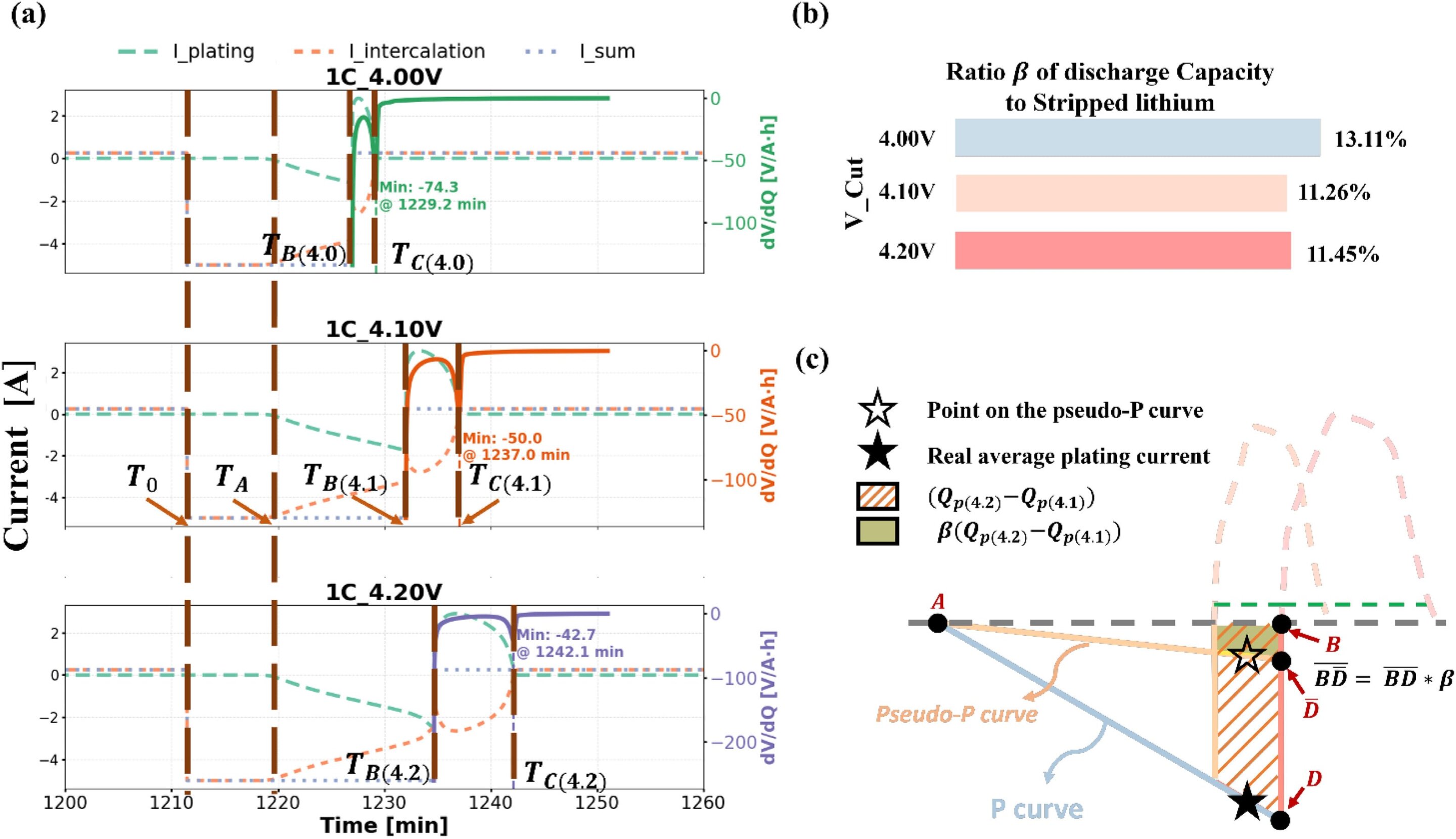
The research team introduces a novel experimental method that generates a pseudo-P curve. This curve shares the same profile as the plating current curve (which can be simulated but not directly measured), varying only by a specific vertical scaling factor. It is found that the intersection of the two curves pinpoints the onset of lithium deposition. Constructing the pseudo-P curve involves identifying the end time of lithium stripping and the corresponding net discharge capacity by varying the charging cutoff voltages.
"Most existing methods can only detect lithium plating after substantial accumulation has occurred and often require cell disassembly," explains Kuo-Ching Chen, Ph.D., professor of applied mechanics at National Taiwan University and the corresponding author of the study. "Our approach identifies the exact moment when lithium plating starts, which is critical for both safety and charging optimization."
The method is validated through experiments on commercial cylindrical batteries and also supported by physics-based electrochemical simulations. The predicted plating onset closely matches simulation results, with errors of only a few percent of total capacity. The team further demonstrates that by reducing the charging current precisely at the predicted onset point, lithium plating could be completely avoided—even under fast-charging and low-temperature conditions.
These findings provide a practical and noninvasive tool for battery diagnostics and open new possibilities for designing faster, safer charging strategies in real-world battery systems.
To see article on TechXplore: https://techxplore.com/news/2026-01-onset-lithium-plating-full-cell.html