

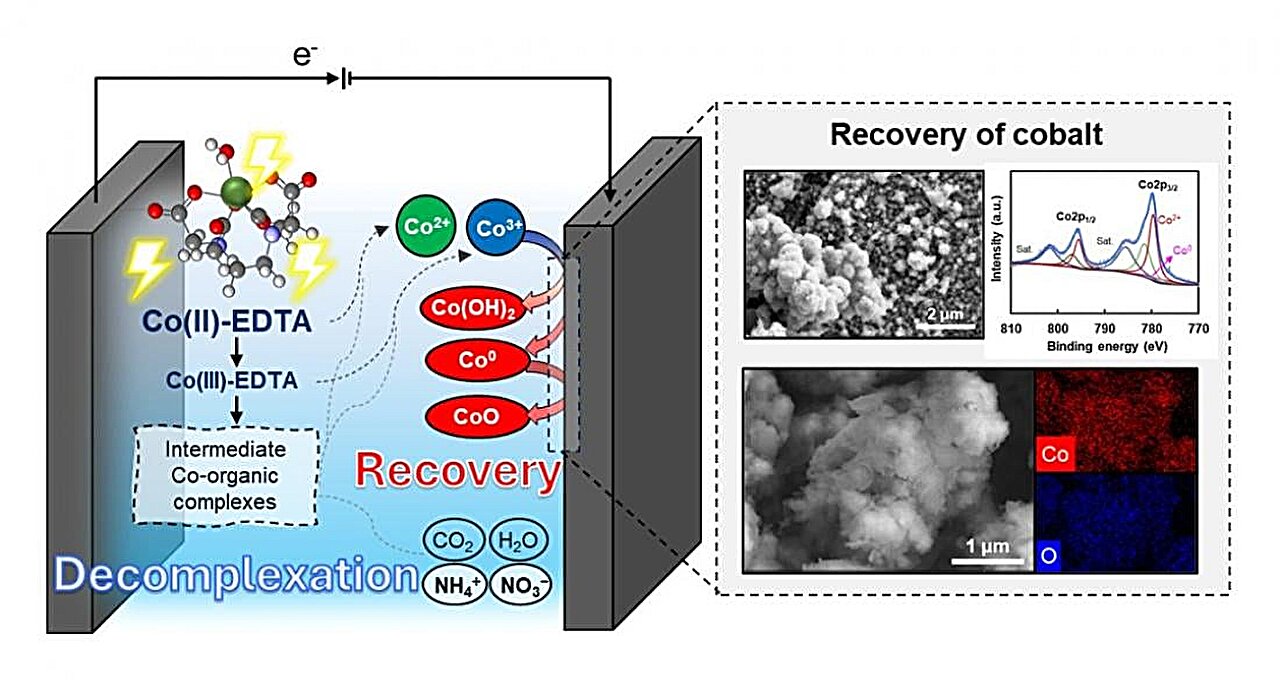
Reagent-free (photo)electrochemical systems effectively break down cobalt–organic complexes while simultaneously recovering cobalt, presenting a promising strategy for advanced wastewater treatment and resource recovery.
Cobalt is an essential component in modern electronics, battery technology, and semiconductor manufacturing. However, industrial use often leaves cobalt trapped in wastewater, tightly bound to chelating agents such as EDTA. These organic chemicals are engineered to keep metals stably dissolved for manufacturing; they create a "hard-to-break" cage around the metal. This stability makes traditional wastewater treatment methods ineffective, thereby posing significant risks to both ecosystems and human health.
In practice, industries typically rely on chemical-intensive oxidation, and downstream precipitation steps may require additional chemicals or multiple treatment steps to break the stable metal-chemical bond before cobalt can be removed. This process significantly raises operating costs and generates significant secondary waste.
Complementary studies published in the Chemical Engineering Journal by a research team led by Prof. Chia-Hung Hou (National Taiwan University) demonstrate that electricity-driven treatment offers a simpler and more sustainable route. By utilizing electrochemical reactions instead of heavy chemical dosing, reactive species generated during the operation can weaken and dismantle the cobalt complexes. This process, known as decomplexation, liberates the cobalt ions into the solution, allowing for the successful recovery of significant amounts of the metal rather than discharging it in the effluent.
In the first study, the researchers developed a photo-electrochemical electrified membrane as an active interface to destabilize the cobalt complex and break down the organic agent. Once the cobalt is liberated, it is captured on the cathode, effectively turning a hazardous contaminant into a recoverable raw material. The team further validated the approach using real semiconductor chemical–mechanical polishing wastewater, confirming its practical applicability beyond laboratory synthetic solutions.
In the second study, the researchers focused on the electrochemical advanced oxidation process and closely tracked the shift between chemical states—from Co(II)-EDTA to Co(III)-EDTA—before the complexes broke down into free cobalt ions and nitrogenous byproducts. Under optimized operating conditions, the team achieved near-complete decomplexation, substantial organic carbon removal, and high cobalt recovery on the cathode.
Taken together, these studies showcase how advanced electrochemical technologies can transform wastewater treatment from a mere pollution-control step into a gateway for resource recovery. By breaking down stubborn cobalt complexes and recovering the valuable metal, these approaches contribute to cleaner water and reduce reliance on mining, which is often linked to environmental and ethical concerns.
"Instead of adding more chemicals, we use electrochemistry to dismantle the cobalt complex and make cobalt recoverable," says Dr. Jhen-Cih Wu, first author of both studies.
"This technology represents a shift from mere pollution control to a circular economy approach," says Prof. Chia-Hung Hou, corresponding author of the studies. "By integrating decomplexation with simultaneous recovery, we demonstrate a sustainable path for transforming hazardous wastewater into valuable resources."
To see article on Phys.org: https://phys.org/news/2025-12-electrochemical-hazardous-cobalt-laden-wastewater.html