

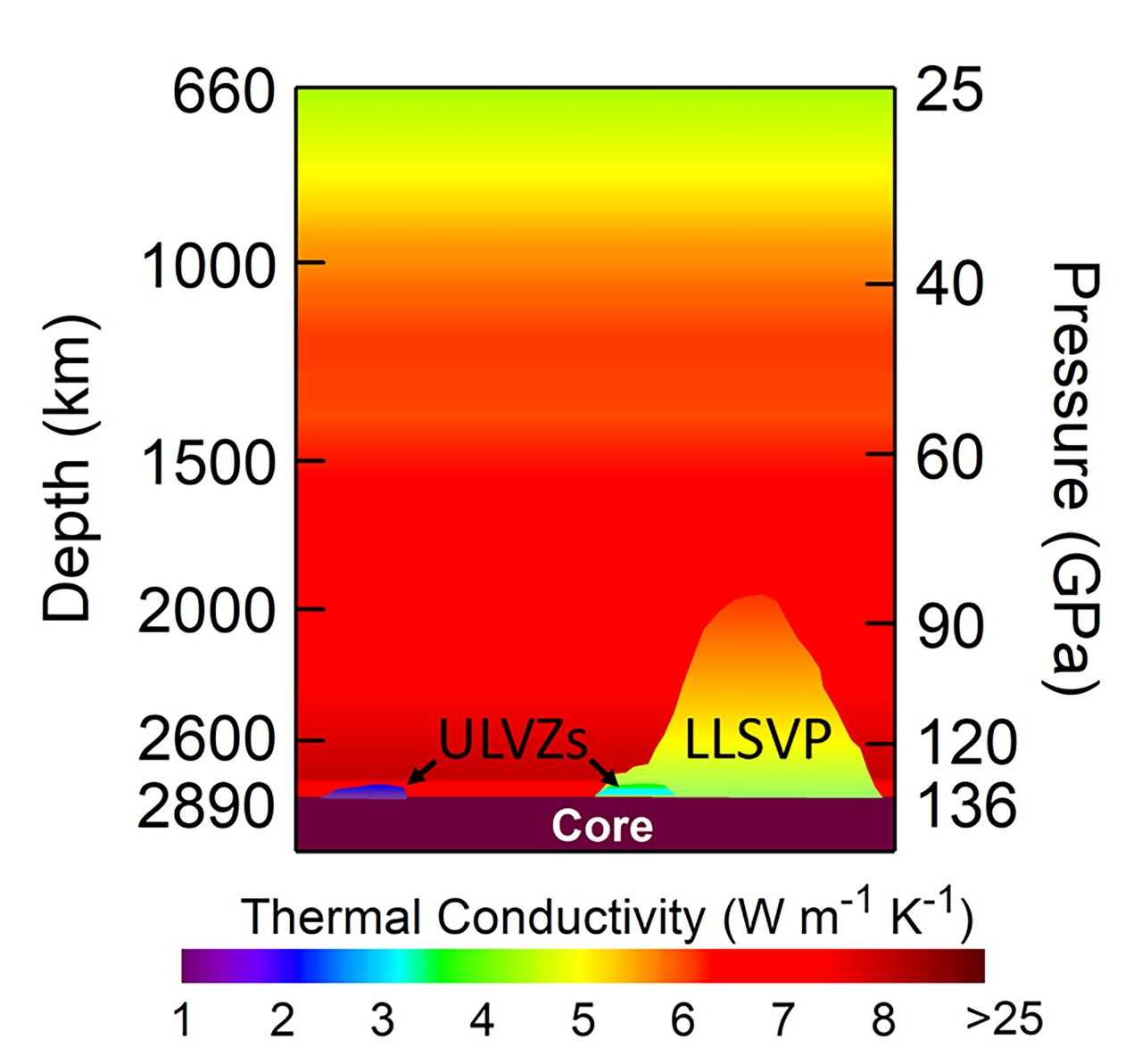
With modern seismic tomography, Earth scientists have discovered that above Earth’s core-mantle boundary (CMB), about 2900 kilometers beneath our feet, there is a thin layer of about 300 kilometers thick with remarkable structural complexity and compositional heterogeneity. Among these features are small-scale structures known as ultralow velocity zones (ULVZs) that have attracted intense scientific interests.
ULVZs are typically only about a hundred kilometers wide and tens of kilometers high, resembling small patches stitched onto the base of the mantle. Despite their limited size, compared to the surrounding mantle, they exhibit anomalously lower seismic velocities and higher density.
Given such extraordinary characteristics, how such small-scale patches affect regional thermochemical evolution and even the energy budget and operation of Earth’s magnetic field, however, has long been one of the major unanswered questions in deep Earth science.
To address this mystery, a recent international collaborative study led by Prof. Wen‑Pin Hsieh, a Research Fellow at the Institute of Earth Sciences, Academia Sinica, and Professor at the Department of Geosciences, National Taiwan University, employed ultrafast optical spectroscopy coupled with high pressure-temperature diamond anvil cells. They have precisely measured the thermal conductivity of iron-rich magnesiowüstite, a candidate thought to form ULVZs. The study is published in Nature Communications.
Surprisingly, the team found that iron-rich magnesiowüstite exhibits an exceptionally low thermal conductivity, way lower than that of the surrounding mantle materials. Their data modelling further suggested that the unique features of ULVZs—low velocity, high temperature, and high density—cause them to behave like localized thermal insulation blankets at the base of the mantle.
These structures can significantly impede the heat transfer from the core into the mantle, altering the spatiotemporal distribution of heat flux across the CMB. In some regions, they may even induce localized thermal stratification at the top of the core. Such effects have profound implications for the thermochemical evolution at both sides of the CMB and the energy budget operating the geodynamo, thereby influencing the polarity and evolution of Earth’s magnetic field.
“These findings represent a significant advance in our understanding of heat transport and geodynamics in Earth’s deep interior, and mark an important step toward unraveling the complex thermochemical and dynamo evolutions operating at the deepest reaches of our planet,” says corresponding author Prof. Wen-Pin Hsieh.
“Of course, we still know very little about it, and need to work hard to better understand the inner working and history of our beautiful planet.”
To see article on Asia Research News: https://www.asiaresearchnews.com/content/mysterious-thermally-insulating-patches-base-earth%E2%80%99s-mantle