

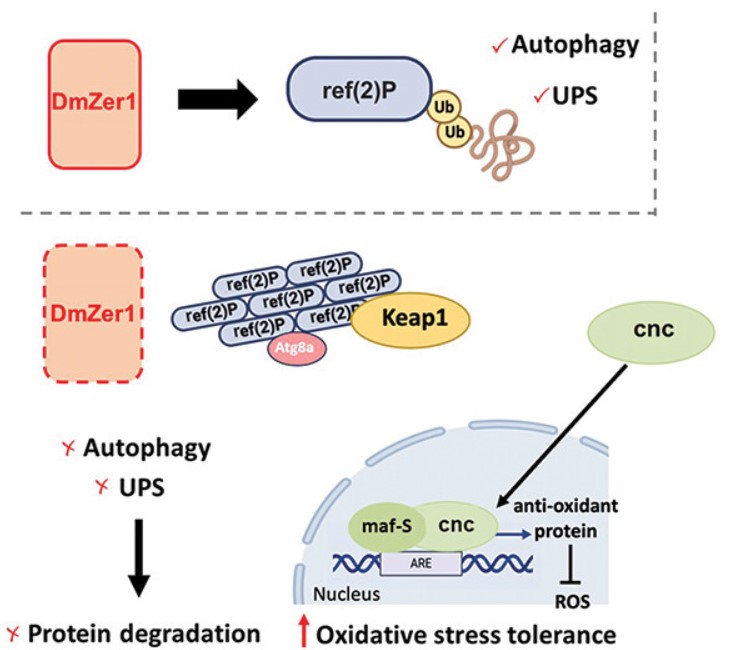
DmZer1: A Key Regulator of Cellular Cleanup Pathways
Protein degradation is essential for keeping cells healthy and in balance. To remove unwanted or damaged proteins, cells rely on two major cleanup systems: the ubiquitin–proteasome system (UPS), which quickly removes short-lived proteins, and autophagy, a recycling pathway that engulfs protein aggregates and damaged organelles. Failures in either pathway can contribute to diseases such as neurodegeneration.
Although these two systems often work independently, they are also tightly interconnected. Our research has uncovered a critical regulator of this crosstalk: DmZer1, the fruit fly version of the human protein ZER1, a component of the Cul2-RING (CRL2) E3 ubiquitin ligase complex. We found that loss of DmZer1 disrupts both autophagy and the UPS, leading to impaired protein degradation and worsened polyQ-induced neurodegeneration. These findings, published in Autophagy, highlight the importance of DmZer1 in maintaining protein quality control.
When DmZer1 Is Missing, Cells Switch On a Stress-Protection Mode
One major discovery is that DmZer1 directly interacts with ref(2)P, the Drosophila homolog of the autophagy receptor p62/SQSTM1. Under stress, p62 proteins form gel-like droplets that trap Keap1, a protein that normally suppresses the antioxidant regulator Nrf2 (called Cnc in flies). By sequestering Keap1, these droplets activate a powerful antioxidant defense program.
When we reduced DmZer1 levels, ref(2)P accumulated and formed these gel-like droplets, capturing Keap1 and activating the Keap1-Cnc/Nrf2 stress-response pathway. This suggests that cells lacking DmZer1 naturally shift into a protective mode. To test this, we exposed DmZer1-deficient flies to paraquat, a chemical that generates harmful reactive oxygen species.
Remarkably, these flies survived significantly longer than normal ones. Their intestines also showed reduced stem cell proliferation, a sign that the antioxidant defense pathway was already activated and providing protection.
Together, these results reveal that loss of DmZer1 not only disrupts protein degradation but also enhances oxidative-stress tolerance, highlighting its dual role in both protein quality control and cellular defense mechanisms.
“Our study highlights how complex and finely tuned protein-quality control is within the cell, and reveals a previously unrecognized regulator that links the proteasome, autophagy, and oxidative-stress pathways,” says Prof. Guang-Chao Chen, corresponding author of the study.
To see article on Asia Research News: https://www.asiaresearchnews.com/content/novel-role-zer1-may-help-cells-combat-neurodegeneration-and-oxidative-stress