

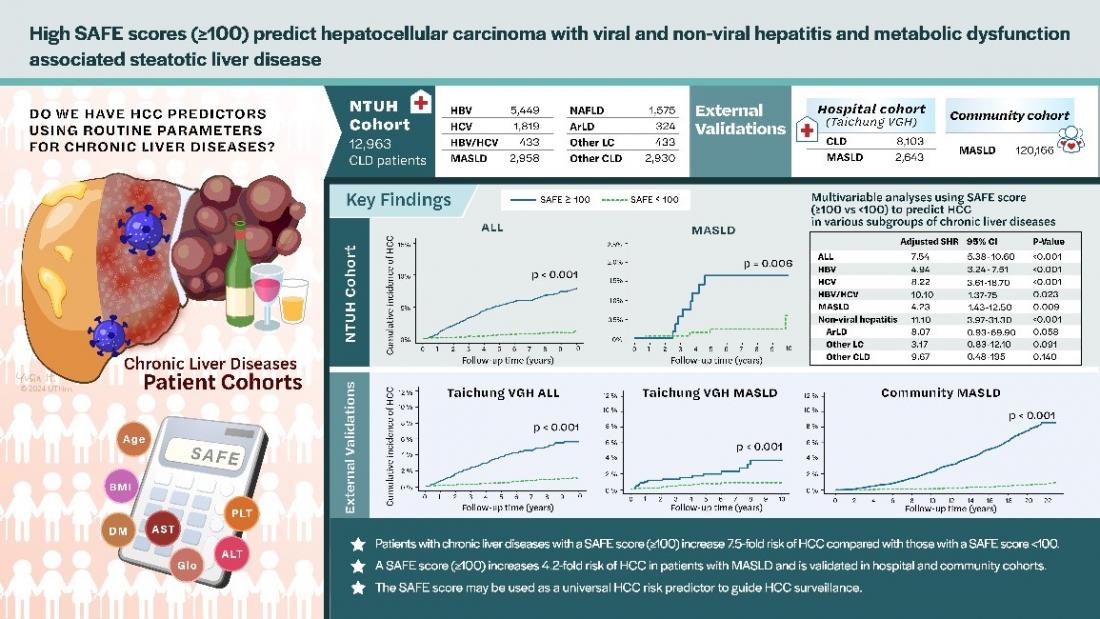
A new scoring system using common clinical parameters accurately identifies chronic liver disease patients with a significantly increased risk of developing liver cancer. This tool acts as a universal predictor, helping doctors guide surveillance recommendations for patients with diverse liver diseases, including metabolic dysfunction associated steatotic liver disease.
Liver cancer, specifically hepatocellular carcinoma (HCC), is a major global health problem, ranking as the third most common cause of cancer-related death worldwide. Current major clinical guidelines have recommended regular surveillance for HCC in high-risk groups, primarily patients with chronic hepatitis B (CHB) or chronic hepatitis C (CHC) infection, or those with cirrhosis.
However, this leaves patients with non-viral chronic liver diseases (CLD)—such as metabolic dysfunction-associated steatotic liver disease (MASLD)—without clear surveillance recommendations. Furthermore, studies have shown that a significant portion (39%) of individuals with MASLD-related HCC do not have cirrhosis, meaning they may be overlooked by existing surveillance guidelines.
Researchers at National Taiwan University explored a solution using the Steatosis-Associated Fibrosis Estimator, or SAFE score. The goal was to create a risk predictor that utilizes simple, readily available clinical parameters, making it easy to incorporate into daily medical practice. The SAFE score calculation includes several widely available parameters: the patient’s age, body mass index (BMI), whether they have diabetes, and routine laboratory values such as aspartate aminotransferase (AST), alanine aminotransferase (ALT), platelet count, and globulin levels.
The study analyzed 12,963 patients with various chronic liver diseases in Taiwan, tracing their health outcomes over a median follow-up of four years. The results clearly demonstrated that the SAFE score is an effective tool for predicting the development of HCC, irrespective of the underlying cause of the patient's liver condition. The results are published in Clinical and Molecular Hepatology.
Specifically, patients with a high SAFE score (100 or higher) had a significantly elevated risk. Compared with patients scoring below 100, the high-risk group had a 7.5-fold increased risk of developing HCC. This high SAFE score was also strongly linked to increased risk in subgroups, including those with MASLD (4.23-fold increased risk) and those with non-viral hepatitis (11.10-fold increased risk).
The power of this new scoring system was confirmed across different settings. The findings were validated using two independent external cohorts: a separate hospital cohort and a large community-based cohort consisting of 120,166 healthy individuals with MASLD. These validations support the use of the SAFE score as a universal risk predictor to guide HCC surveillance, particularly in conditions like MASLD and alcohol-related liver disease, where dedicated risk scores are currently unavailable.
Even for patients with viral hepatitis who were already undergoing antiviral treatment, the SAFE score is capable of accurately classifying their ongoing risk of developing HCC. The high negative predictive value (NPV) of the SAFE score indicates it is very effective at ruling out patients at low risk of developing HCC.
“Our findings strongly suggest that this simple, readily available tool can identify patients at high risk of HCC across all chronic liver disease causes, paving the way for better surveillance guidelines for everyone,” says Prof. Jia-Horng Kao, corresponding author of the study.
“The SAFE score supports an unmet clinical need, allowing us to stratify risk in patients with non-viral conditions like MASLD, encouraging at-risk people to start regular surveillance of HCC,” says Prof. Tung-Hung Su, the study’s first author.
To see article on Asia Research News: https://www.asiaresearchnews.com/content/simple-blood-test-formula-identifies-patients-high-risk-liver-cancer