

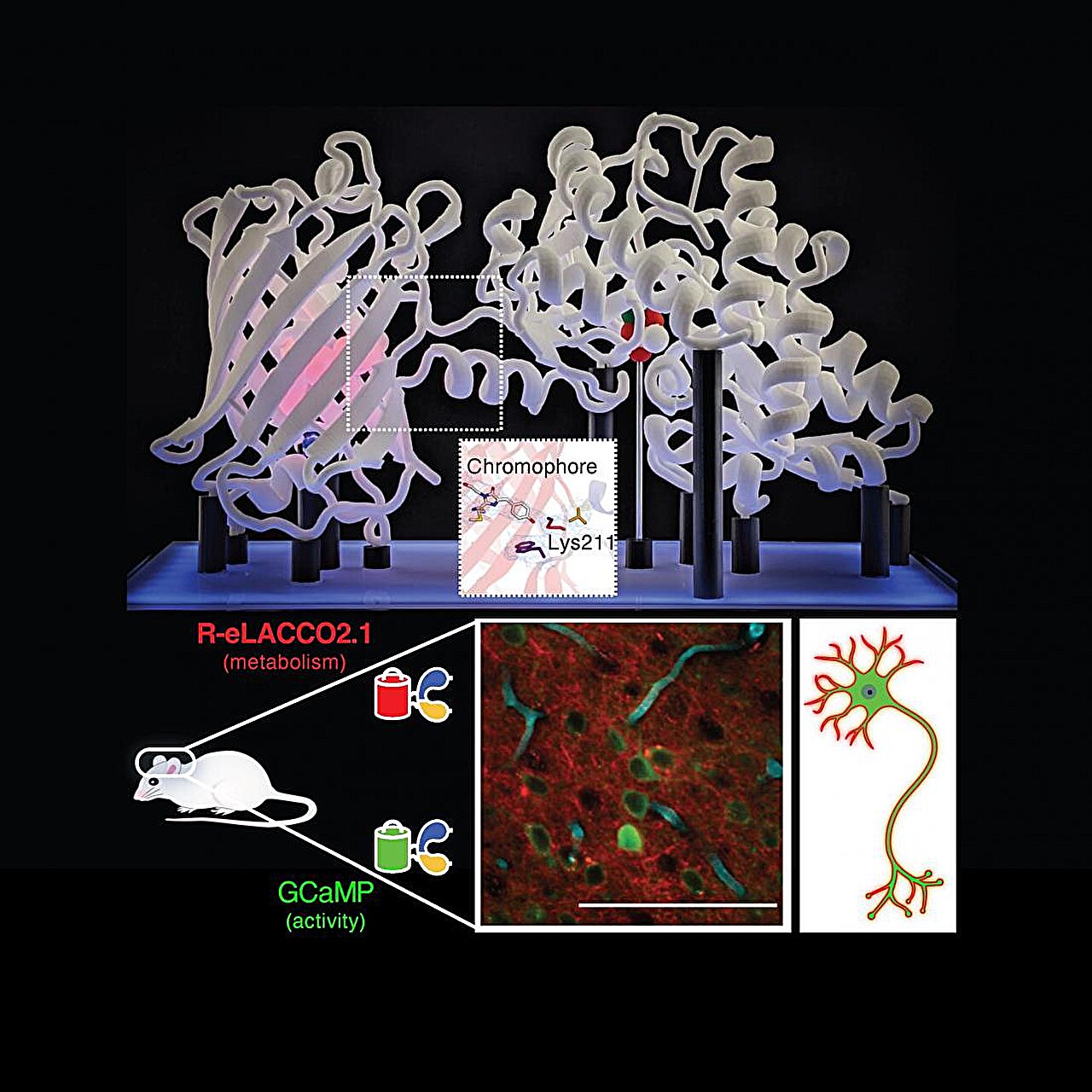
Scientists from Academia Sinica and National Taiwan University, together with international collaborators, have developed a high-performance red fluorescent biosensor for lactate (lactic acid). The new biosensor, named R-eLACCO2, allows researchers to visualize how lactate levels change in real time inside living mice. When used alongside a green fluorescent biosensor, it opens up new possibilities for studying how metabolism and brain activity interact. The study is published in Nature Communications.
Redefining lactate's role
For decades, lactate was thought to be merely a by-product of glucose breakdown—best known for causing muscle fatigue during exercise or contributing to acidosis. However, recent discoveries have transformed this view, revealing that lactate serves as a key energy source and signaling molecule across many tissues, including the brain.
To uncover lactate's diverse roles, scientists need tools that can track its dynamics directly inside living tissues. One promising approach is genetically encoded fluorescent biosensors, which are proteins that glow when they bind to a specific molecule such as lactate. Because these biosensors can be produced within cells and tissues, they enable high-resolution imaging of metabolic dynamics in living animals.
Dr. Yusuke Nasu, Assistant Research Fellow at the Institute of Biological Chemistry, Academia Sinica and Adjunct Assistant Professor of Biochemical Sciences at National Taiwan University, and his team have long pioneered this technology. They previously developed green fluorescent lactate biosensors eLACCO1.1 and eLACCO2.1. While powerful, these earlier versions emitted only green light, making it difficult to combine them with other green biosensors in the same experiment.
Expanding research possibilities with R-eLACCO2
The newly developed R-eLACCO2 overcomes this limitation. It emits red fluorescence that changes intensity depending on lactate levels, functioning reliably in cultured cells, brain slices, and even awake, living mice. This allows scientists to observe lactate metabolism and neuronal activity simultaneously, by pairing R-eLACCO2 with a green calcium biosensor.
"We believe that technology drives new science," said Dr. Nasu, senior author of the study. "Our mission is to develop high-performance tools that empower researchers worldwide. The LACCO series of biosensors, including R-eLACCO2, has already been shared with more than 90 research groups in 19 countries. They are also available through Addgene, the Canadian Neurophotonics Platform Viral Vector Core (CNPVVC), and the Bloomington Drosophila Stock Center (BDSC). Open science is at the heart of what we do."
The research team now aims to expand the color palette of lactate biosensors and create similar tools for other key metabolites. These advances will further illuminate how cells manage and communicate energy, providing new insights into health and disease.
To see article on Phys.org: https://phys.org/news/2025-11-red-lactate-biosensor-door-simultaneous.html