

A research team from National Taiwan University, Academia Sinica, and National Taiwan University Hospital has uncovered a critical connection between a unique RNA molecule and human aging, including early-stage Alzheimer's disease. Their findings, recently published in Nucleic Acids Research, spotlight TERRA—a long non-coding RNA transcribed from the ends of chromosomes—as a potential biomarker for age-related and neurodegenerative conditions.
TERRA, short for Telomeric Repeat-Containing RNA, originates from the ends of chromosomes (telomeres) and consists of repetitive UUAGGG sequences and subtelomeric sequences that are unique to each chromosome. While TERRA is known to be involved in telomere biology, its precise role in human aging has remained elusive.
To overcome the technical challenges in studying TERRA—such as its repetitive nature and unassembled genomic regions—the team used Oxford Nanopore direct RNA sequencing and the recently completed T2T-CHM13 human genome reference. By enriching TERRA transcripts and mapping their locations, they produced the first comprehensive annotation of TERRA transcription regions across all chromosome ends.
The researchers developed a computational tool, TERRA-QUANT, which allows for robust analysis of TERRA levels from any RNA-seq dataset, including bulk tissue and single-cell data. Using this tool, they analyzed large-scale RNA sequencing datasets from human tissues across various ages.
Key discoveries include:
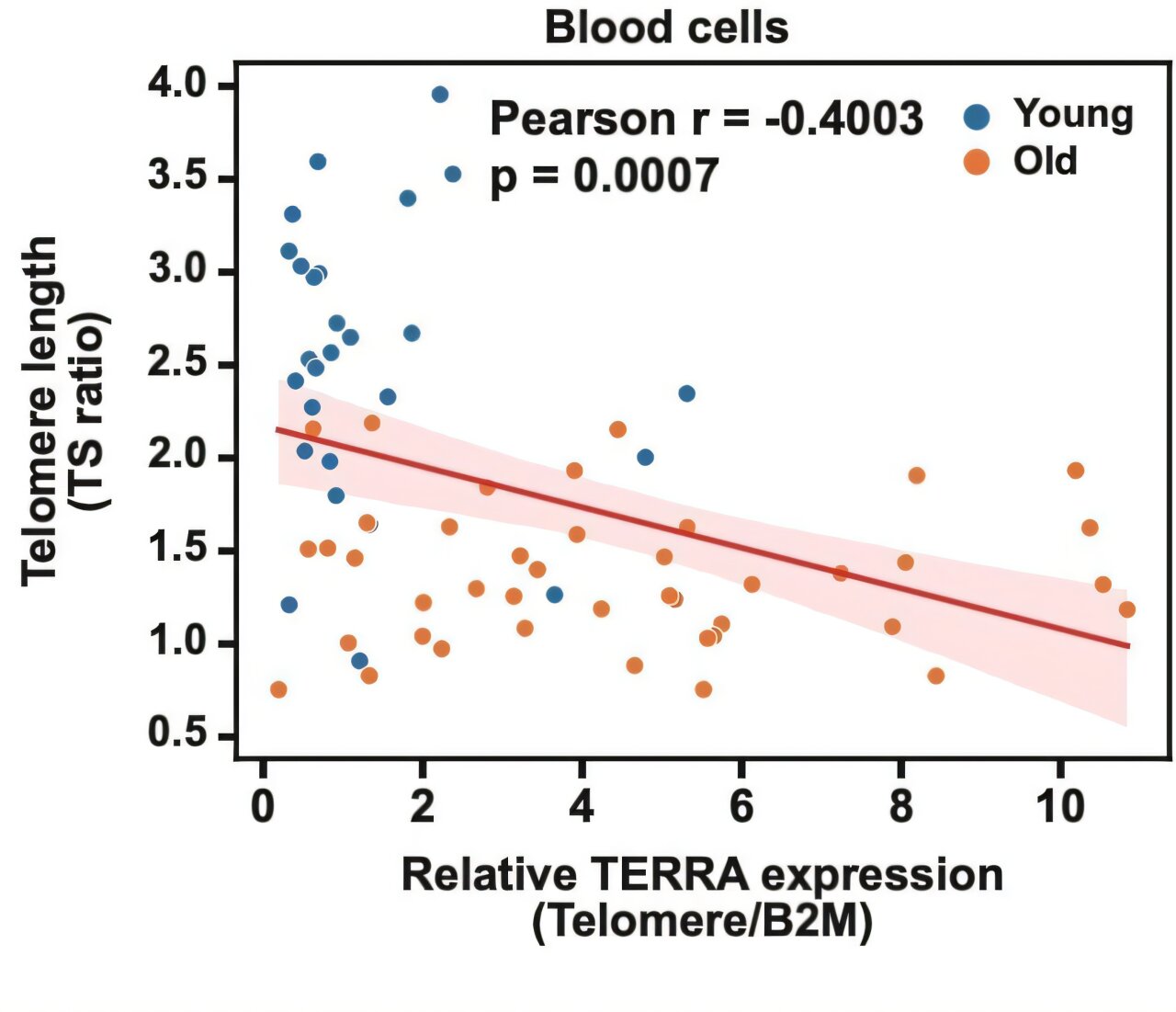
- TERRA levels increase significantly with age in human blood, brain, and fibroblast tissues.
- Dysregulated TERRA expression is seen in fibroblasts in patients with Hutchinson-Gilford Progeria Syndrome (HGPS)—a rare condition causing premature aging.
- Single-cell data revealed increased TERRA expression in neurons derived from embryonic stem cells and during the early stages of Alzheimer's disease.
They validated their findings using RT-qPCR, confirming the upregulation of TERRA in aged blood cells and neurons derived from patients with Alzheimer's disease.
"These results suggest that TERRA is not only a marker of cellular aging, but may also play a functional role in age-related diseases," said Dr. Hsueh-Ping Catherine Chu, the lead investigator of the study.
This study is the first to demonstrate that TERRA expression is associated with aging and early neurodegeneration in humans. It also establishes a new framework for exploring how TERRA can be used to understand and potentially monitor aging-related conditions.
More information: Yu-Hung Hsieh et al, Telomeric repeat-containing RNA increases in aged human cells, Nucleic Acids Research (2025). DOI: 10.1093/nar/gkaf597
Journal information: Nucleic Acids Research